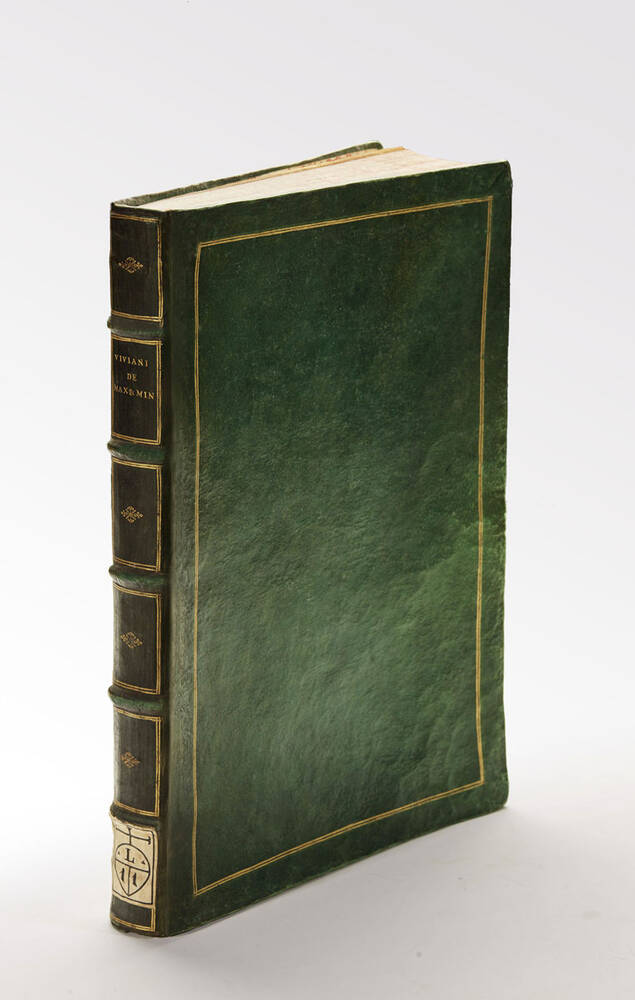
VIVIANI, Vincenzo. De maximis et minimus geometrica divinatio in quintum cononicorum Apollonii pergaei.
Florence, Giuseppe Cocchini., 1659.Folio (333 x 230 mm.), [16], 154; [4], 154, [2, errata] pp. Half-title, titles in red & black with woodcut arms of Grand Duke Ferdinand II. Correction slips pasted down to line 18, p 32 and line 8 p 118. With 4 full page engraved plates (2 on one folding sheet), and numerous woodcut text diagrams. Light scattered foxing, overall a a very good copy in contemporary green vellum with double gilt fillet border, spine gilt in compartments from the library of Marchesi Corsi, Villa Corsi-Salviati, Sesto Fiorentino (engraved bookplate by Zocchi).
First edition of the first published work by Viviani, ‘the most able restitution of the lost Fifth Book of the Conic Sections of Apollonius Pergaeus, made previously to the discovery of Borelli of its existence in an Arabic Version’. (Libri Cat., Auction 1861, nr.3138) Vincenzo Viviani (Florence 1622 – 1702) was a disciple of Galileo and lived with him in Arcetri for three years. ‘Throughout his life, one of Viviani’s main interests was in ancient Greek mathematics. As early as 1646, while collaborating with Torricelli, he was also working on a project to restore the work of Aristaeus the Elder. Pappus gave Aristaeus great credit for a work entitled Five Books concerning Solid Loci which had been lost. (Solid Loci is the Greek term for conic sections.) Pappus, however, indicated propositions from the work and Viviani reconstructed the original from these references by Pappus. It was a project that Viviani worked on for most of his life. In 1673 he published a first edition of his restoration but he continued to work on it and his final effort De locis solidis secunda divinatio geometrica in quinque libros iniuria temporum amissos tristaei senioris geometrae was published in 1701 only, two years before his death. Another restoration of a Greek text by Viviani is interesting for a number of reasons. This was his restoration of the fifth book of Apollonius’s Conics. At the time he began the restoration only the first four books of this eightbook work had been found and Viviani set about reconstructing the fifth. By 1656 Viviani’s work was quite close to completion when Giovanni Alfonso Borelli (a fellow Tuscan Court mathematician) discovered an Arabic version of the first seven books of Apollonius’s Conics in the Laurentian Library in Florence. Borelli took the manuscript to Rome where it was translated into Latin by Abrahamus Ecchellensis. In 1659 both the translation from the Arabic and Viviani’s restoration were published. Viviani’s work was entitled De maximis et minimis geometrica Divinatio and was certainly written by him without any knowledge of the translation of Apollonius’s work. It is interesting, of course, to see how faithfully Viviani was able to reconstruct Apollonius’s book since now both the reconstruction and the original had become available. Viviani had done an excellent job, his biggest ‘error’ being that he had been able to penetrate deeper than Apollonius himself. The realisation that Viviani was, in some sense, a better geometer than the revered Apollonius, gave him instant fame throughout the centres of learning in Europe. His reputation as a mathematician was high throughout Europe. Louis XIV of France offered him a position at the Académie Royale in 1666, and John II Casimir of Poland offered Viviani a post as his astronomer, also in 1666. The Grand Duke, not wishing to lose Viviani, appointed him as his mathematician. Viviani accepted this post and turned down the offers from Louis XIV and John II Casimir’. (www-history. mcs.st-andrews.ac.uk/Biographies/Viviani.html)
Carli & Favaro 400; Cinti 135; Honeyman VII 3061; Riccardi II 625.
Other Books
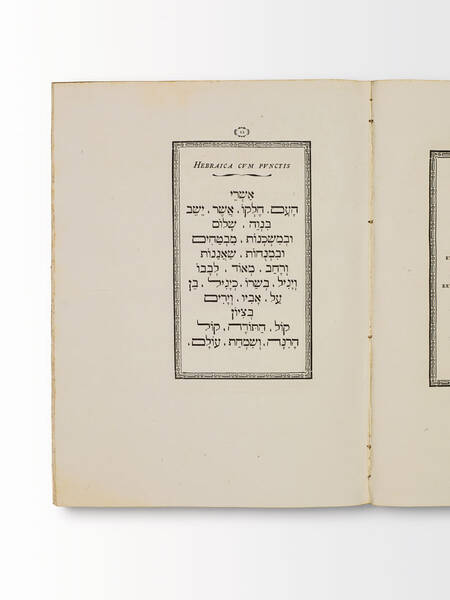
[BODONI]
Pel solenne battesimo di S.A.R. Ludovico Principe primogenito di Parma tenuto al sacro fonte da Sua Maestà Cristianissima e dalla Reale Principessa...
€ 6.000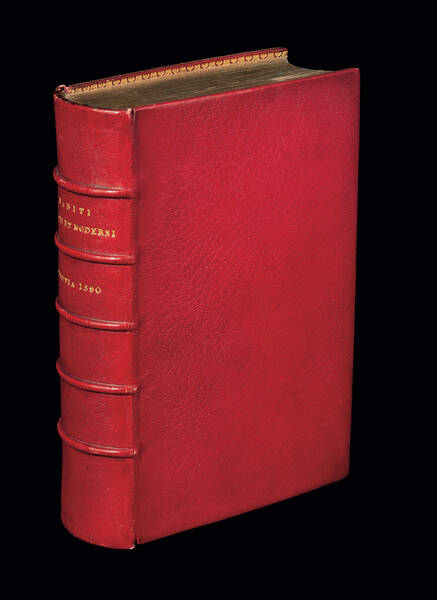
VECELLIO, Cesare
Degli Habiti Antichi, et Moderni di Diverse Parti del Mondo Libri due, fatti da Cesare Vecellio, & con Discorsi da Lui Dichiarati.
SOLD OUT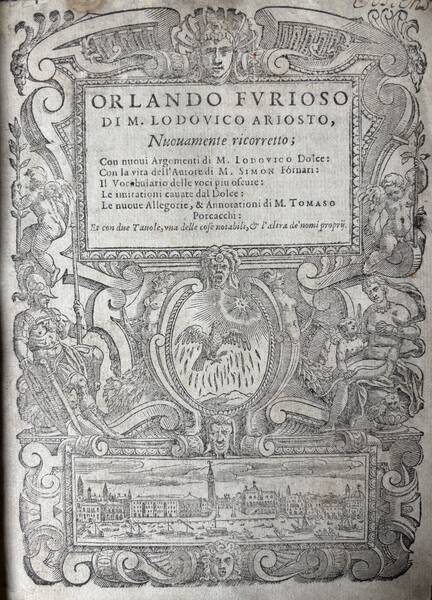
ARIOSTO, Ludovico
Orlando Furioso di M. Lodovico Ariosto, nuovamente ricorretto; con nuovi argomenti di M. Lodovico Dolce: con la vita dell'autore di M. Simon Fornari:...
€ 3.000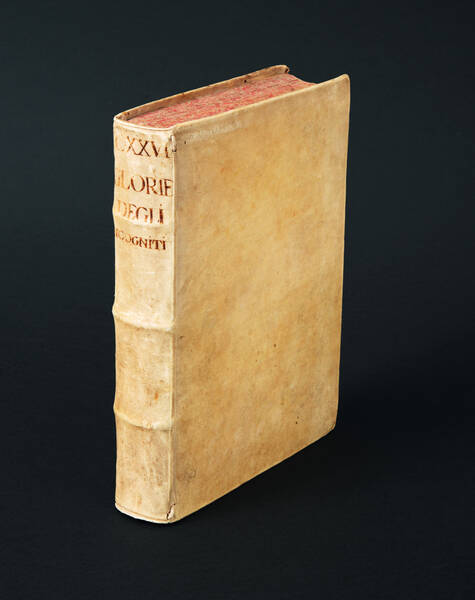
[BRUSONI, Girolamo]
Le glorie de gli Incogniti o vero gli huomini illustri dell'Accademia de' signori Incogniti di Venetia.
€ 8.000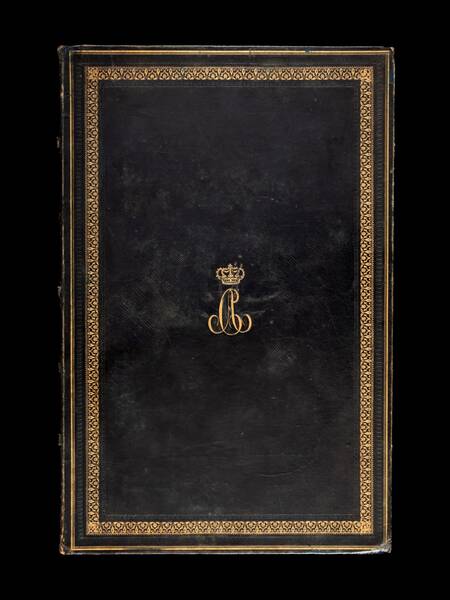
[CIBRARIO, Luigi]
Giostra corsa in Torino addi 21 di febbraio 1839 nel passaggio di Sua Altezza Imperiale e Reale Alessandro gran-duca principe imperiale ereditario di...
€ 2.500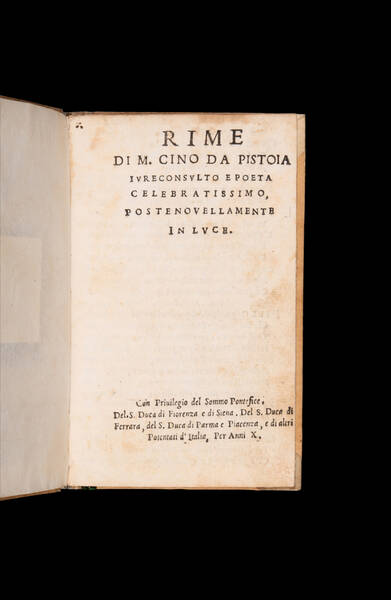
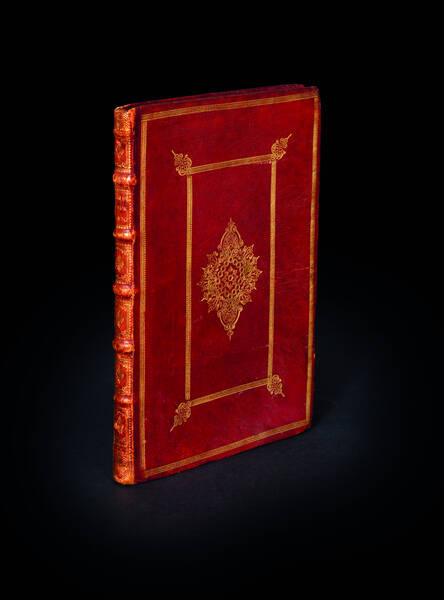
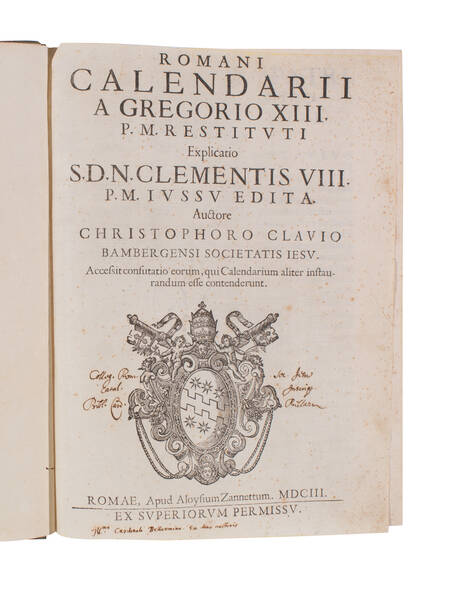
CLAVIUS, Christoph
Romani calendarii a Gregorio XIII. P.M. restituti Explicatio S.D.N. Clementis VIII. P.M. iussu edita.
SOLD OUT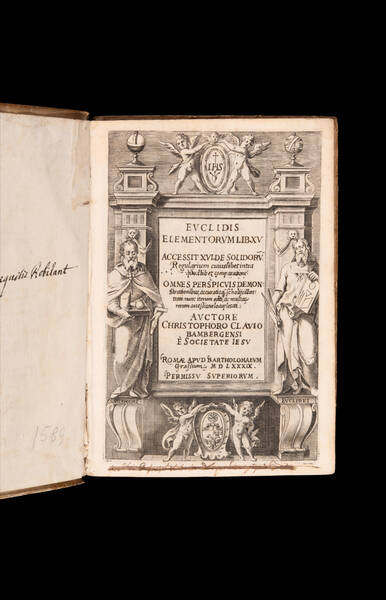
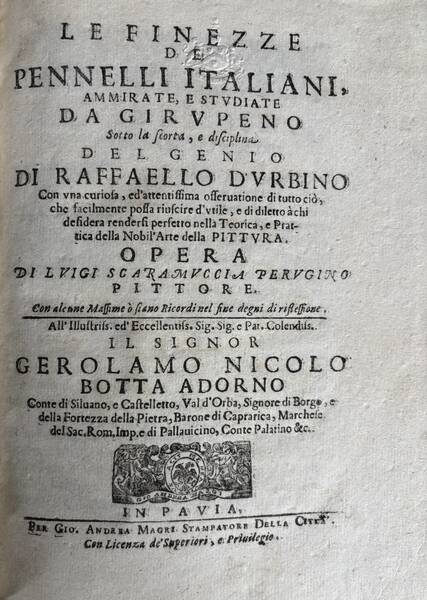
SCARAMUCCIA, Luigi
Le finezze de pennelli italiani, ammirate, e studiate da Girupeno sotto la scorta, e disciplina del genio di Raffaello d'Urbino : con una curiosa,...
€ 1.200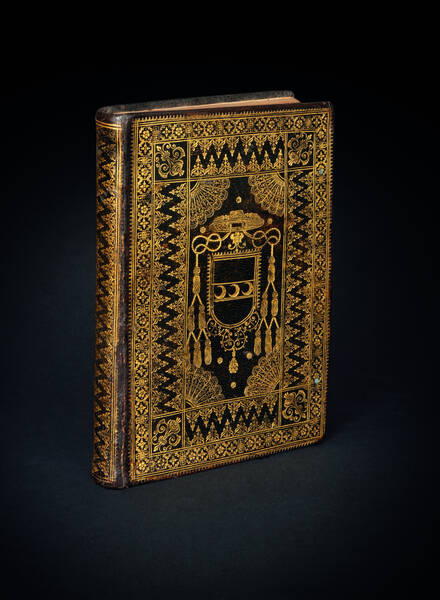
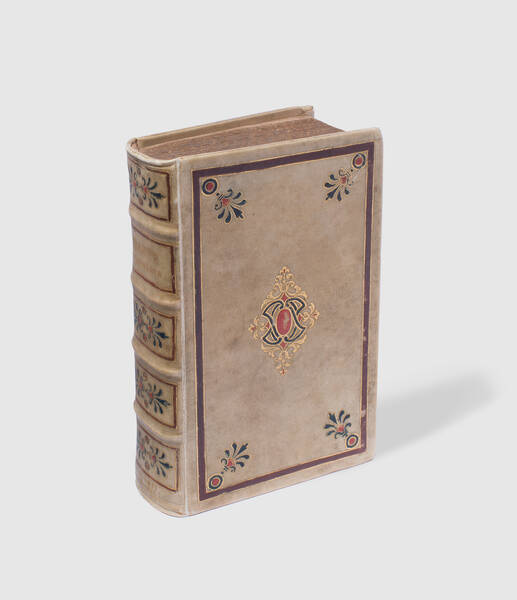
ALIGHIERI, Dante
Commedia di Dante insieme con vno dialogo circa el sito forma et misure dello Inferno.
SOLD OUT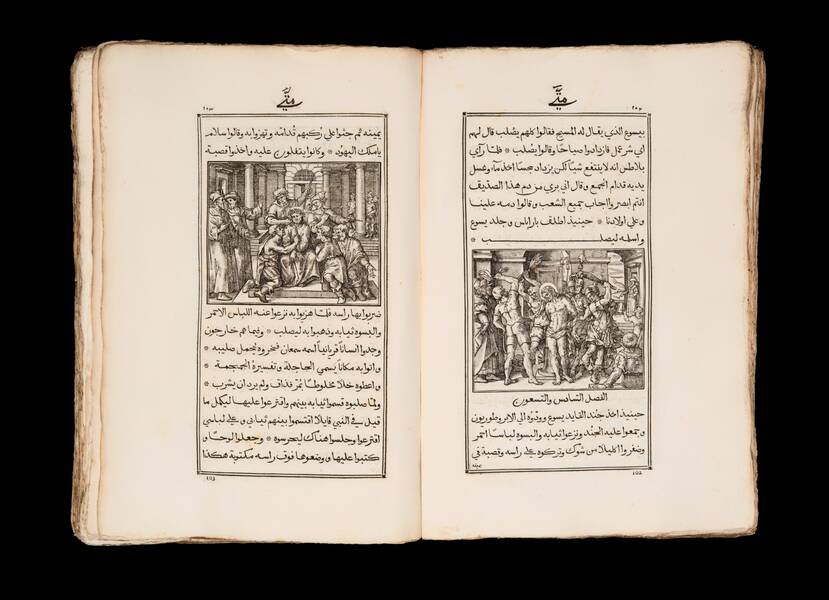
[BIBLIA ARABICA]
Evangelium Sanctum Domini nostri Iesu Christi conscriptum a quatuor Evangelistis sanctis, id est Matthaeo, Marco, Luca et Iohanne.
SOLD OUT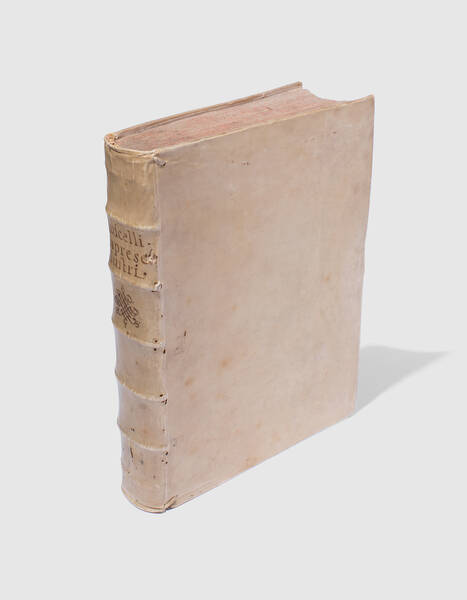
RUSCELLI, Gerolamo
Le imprese illustri con espositioni, et discorsi del s.or Ieronimo Ruscelli.
SOLD OUT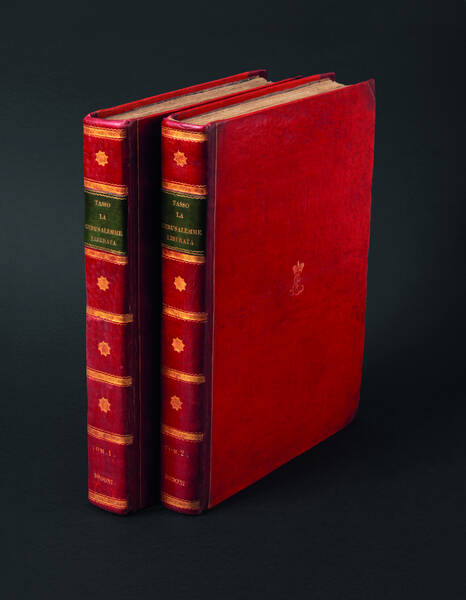
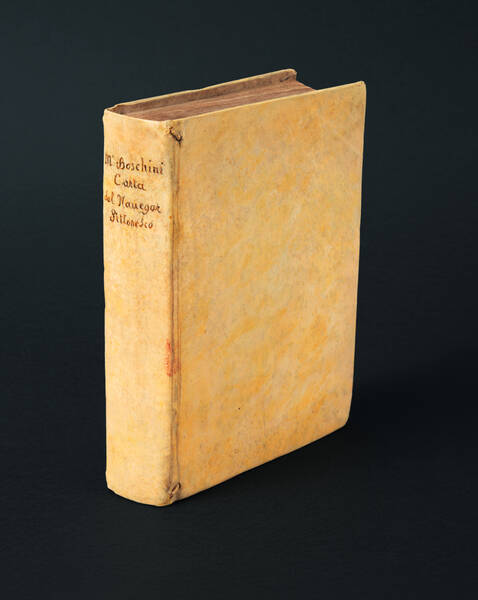
BOSCHINI, Marco
La carta del nauegar pitoresco dialogo tra vn senator venetian deletante, e vn professor de pitura, soto nome d'ecelenza, e de compare. Comparti' in...
€ 7.000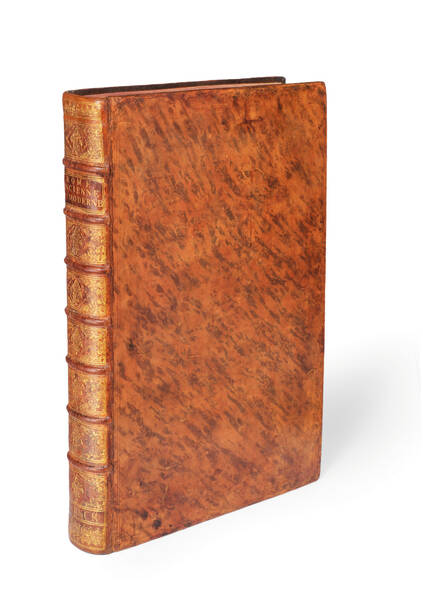
MEDA RIQUIER rare books ltd.
4 Bury Street St James's
SW1Y 6AB London
Phone +44 (0) 7770457377
info@medariquier.com