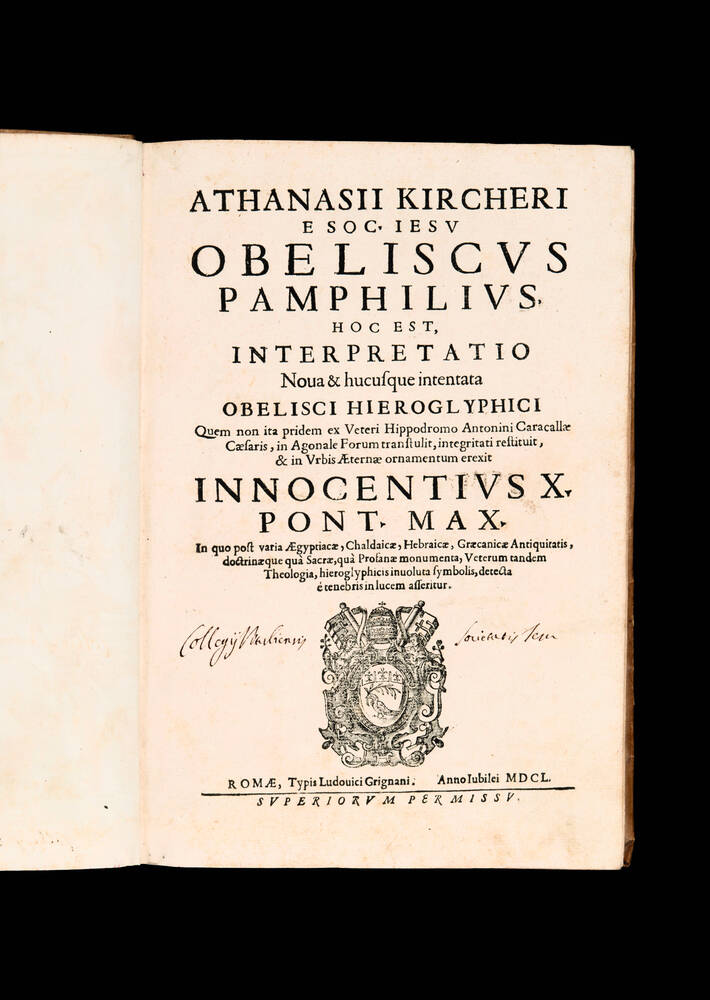
KIRCHER, Athanasius. Obeliscus Pamphilius, hoc est, interpretatio nova & hucusque intentata obelisci hieroglyphici.
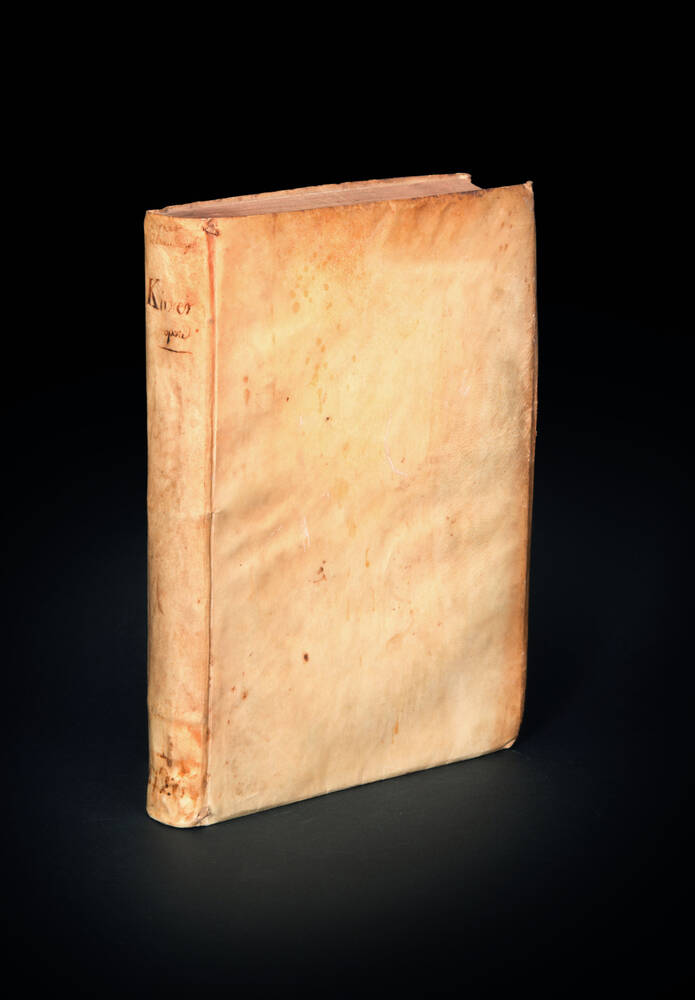
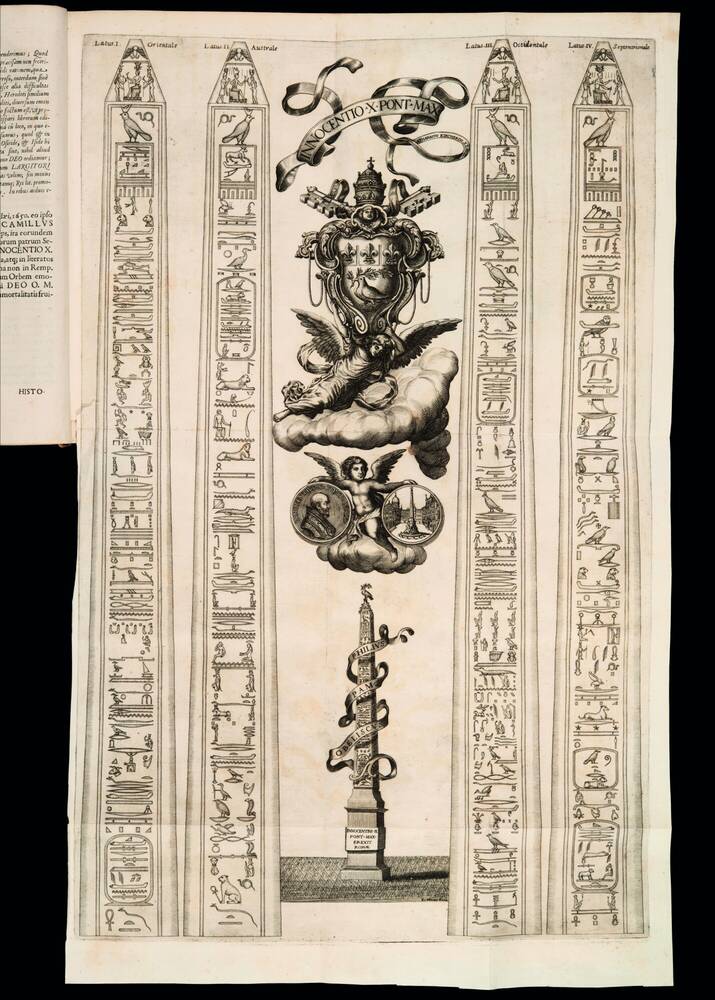
Rome, typis Ludovici Grignani., 1650.Folio (321×220mm). [32] leaves, 560 [i.e. 558] pages, [15] leaves. Printed in Roman type, featuring Arabic, Hebrew, Greek and Coptic types. Allegorical frontispiece engraved by Cornelis Bloemaert after a drawing by Giovanni Angelo Canini. Title-page with the arms of Pope Innocent X, and the pope's engraved portrait on a2. Five full-page engraved plates and a large folding plate with the four sides of the obelisk; several illustrations, initials and ornaments throughout. Few leaves lightly browned, light marginal foxing, tear at leaf T1, three leaves with minor marginal losses not affecting the text; manuscript inscription: Collegij Vindebonensis Societatis Iesu on title-page and at the bottom of the frontispiece. A very fine copy in contemporary limp vellum binding with manuscript title and author on spine.
First edition of Athanasius Kircher's treatise on the Pamphili Obelisk in Rome's Piazza Navona, and a landmark work in the history of Egyptology. In 1651, Pope Innocent X commissioned Gian Lorenzo Bernini to build the Fontana dei Quattro fiumi in Piazza Navona. The fountain, one of Bernini's major works and a masterpiece of Roman Baroque sculpture, is topped by an Egyptian obelisk from the time of Emperor Domitian: this was originally installed in the Temple of Isis, on the Campus Martius, and was later moved by Emperor Maxentius to adorn the circus he had constructed on the Appian Way. Left in ruins during the Middle Ages, in 1647, under the newly-elected Innocent X the obelisk was relocated to the site where it stands today, where it was then incorporated into Bernini's fountain. Pope Innocent X's expensive and ambitious project was intended to celebrate his own family, the powerful House of Pamphili, whose palace overlooks Piazza Navona. "The enterprise boasted a unique scholarly contributor as well: the German Jesuit Athanasius Kircher, whose task it had been to translate the obelisk's hieroglyphic inscriptions — a century and a half before the discovery of the Rosetta stone. To many people's minds he had succeeded." (Rowland, p. 153) At the time, Kircher was a professor of mathematics in the Roman College, and one of Europe's most renowned scholars. "By the time he published Obeliscus Pamphilius, he was forty-eight years old and had already written several books, on subjects ranging from magnetism to the Coptic language and its possible relationship with ancient Egyptian hieroglyphs. He had also written pamphlets describing some of his mechanical inventions. Obeliscus Pamphilius, however, represented a new degree of ambition, both as a physical object and as an intellectual enterprise. A folio volume of five hundred pages, it was impressive simply for its bulk, but Obeliscus Pamphilius was also an exceedingly well-made book. Publication had been delayed until Kircher could employ the fine set of Arabic type he had been promised for years from the grand duke of Tuscany but only received in 1650. The best engravers in Rome provided illustrations, lavishing their greatest skill on a full-page portrait of the pope and a foldout view of the Pamphili obelisk from all four sides." (ibid., p. 154) "Although Kircher's translation of the inscriptions on the obelisk of Domitian provided the initial pretext for writing Obeliscus Pamphilius, the translation itself took up only the last fifth of the book. First (after a series of properly deferential dedications to the pope, the emperor, and ‘Readers experienced in Recondite Literature' […], Kircher supplied a history of the obelisk. […] The next three books provided an introduction to what ancient Egyptian culture had meant in the ancient Greek, Roman, and Hebrew world, to its influence on early Islam and rabbinical tradition, and finally to its significance to contemporary society. Here, especially, Kircher made conspicuous use of his new Arabic font amid the Hebrew, Coptic, and Greek typefaces with which he worked as a matter of course. […] On the basis of this magisterial introduction to Egypt and to himself, Kircher at last proceeded in book 5 to interpret the hieroglyphic texts of the Pamphili Obelisk. Because the delicate carvings in its granite had been partly damaged by time and transport, Kircher's transcription included a number of his own reconstructions and conjectures." (ibid., pp. 156–157) Kircher's method was largely influenced by Renaissance neoplatonic philosophers such as Marsilius Ficinus, who had translated the Corpus Hermeticum. Specifically, Kircher believed that hieroglyphs were invented by Hermes Trismegistus, a mythical figure who lived before Moses, and that they were the medium through which ancient Egyptians conveyed the original knowledge that was handed down to humankind by Adam. Therefore, hieroglyphs cannot simply be considered a writing system like any other. Instead, they have a profound symbolic value as initiatory symbols to divine truth, and should be interpreted rather than translated. "The only key available to Kircher for an interpretation of hieroglyphs is what he knows (or, better, what he thinks he knows) about Egyptian culture. The technique, which Kircher creates, is made up of four steps. The first step consists in organizing pictures of various kinds: animals (lions, doves, vultures, crocodiles, dogs, snakes and beetles) and plants (leaves, reeds, lotus and so on). There are also 'mixed' pictures, such as men with animal heads, and geometric shapes (crosses, spheres, triangles and squares). The second step consists in organizing elementary pictures into a list, in which Kircher associates a parallel list of immediate meanings. The third step is the link between one picture and other meanings, either according to philological considerations or, more often, out of a mere logical deduction. For example, the picture of a lion is associated with the concept of a god, because when the Sun enters the sign of Leo, the river Nile overflows, bringing benefits to the land of Egypt. The fourth crucial step, largely based on intuition, consists of attributing a meaning to compound hieroglyphs: a sphere, for example, may indicate ‘the world'; however, if the sphere is underneath a snake, the meaning is animated world." (Buonanno, pp. 143–144) Despite his lack of a scientific methods of translation, Kircher's study was the most ambitious attempt at deciphering Egyptian hieroglyphs prior to Jean- François Champollion's breakthrough in 1822, which was only made possible by the discovery of the Rosetta stone during Napoleon's campaign in Egypt.
Backer-Sommervogel IV 1052; Brunet III 668; Caillet 5787; Cicognara 2526; Merrill 9; Buonanno, Roberto. The Stars of Galileo Galilei and the Universal Knowledge of Athanasius Kircher. Springer: 2014; Rowland, Ingrid. "The United Sense of the Universe": Athanasius Kircher in Piazza Navona." Memoirs of the American Academy in Rome, vol. 46 (2001), pp. 153–181.
Other Books
ALIGHIERI, DANTE
La Divina Comedia Di Dante, di nuouo alla sua vera lettione ridotta con lo aiuto di molti antichissimi esemplari. Con argomenti, et allegorie per...
SOLD OUT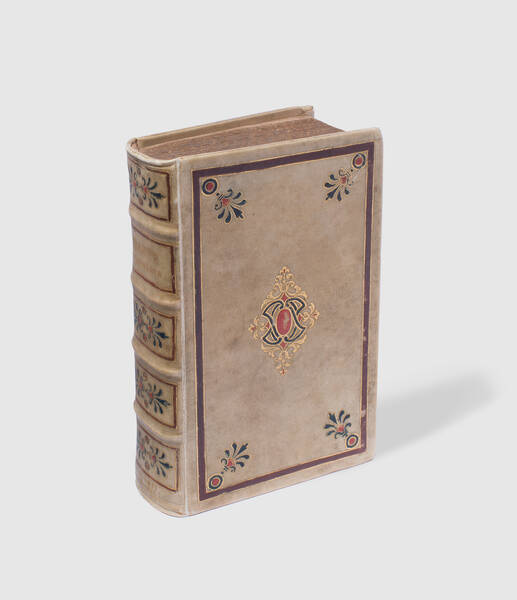
ALIGHIERI, Dante
Commedia di Dante insieme con vno dialogo circa el sito forma et misure dello Inferno.
SOLD OUT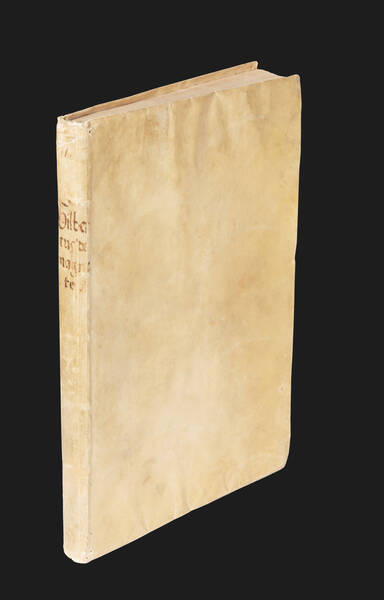
GILBERT, William
De magnete, magneticisque corporibus, et de magno magnete tellure; Physiologia nova, plurimis & argumentis, & experimentis demonstrata.
SOLD OUT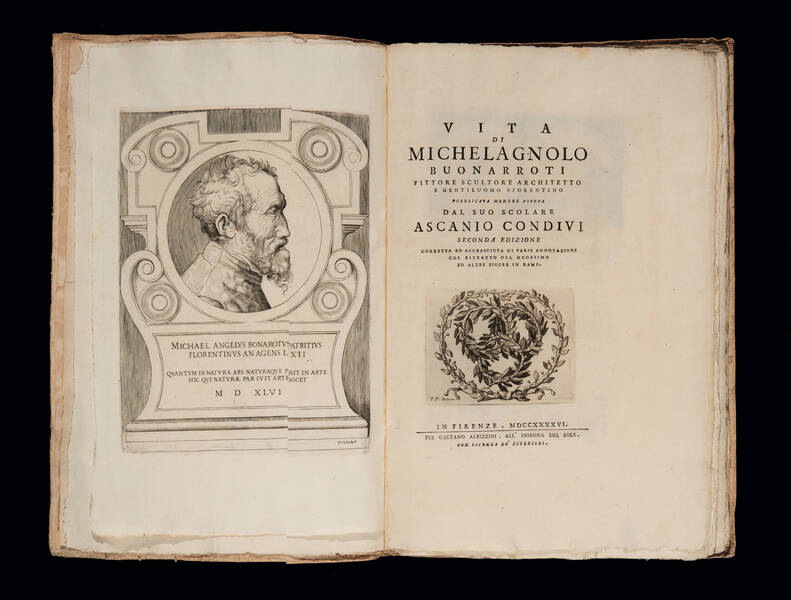
CONDIVI, Ascanio
Vita di Michelagnolo Buonarroti pittore scultore architetto e gentiluomo fiorentino pubblicata mentre viveva dal suo scolare Ascanio Condivi.
SOLD OUT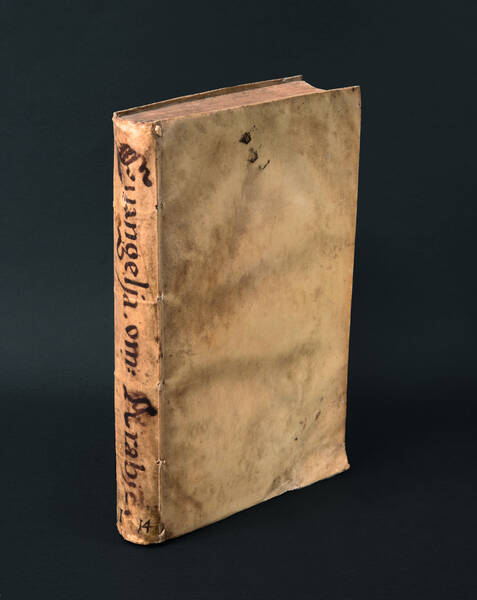
[BIBLIA ARABICA]
Evangelium Iesu Christi quemadmodum scripsit Mar Mattheus unus ex duodecim discipulis eius.
€ 11.000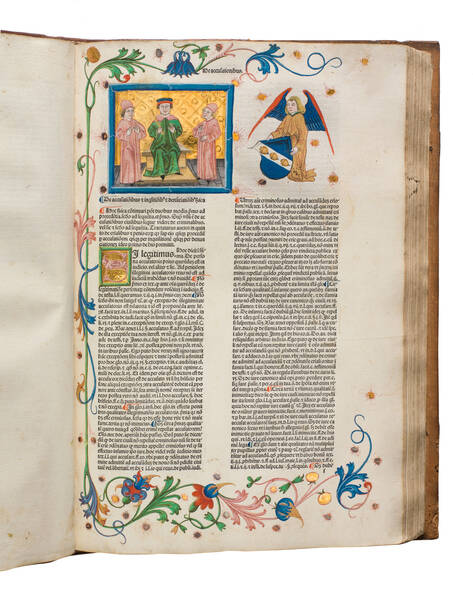
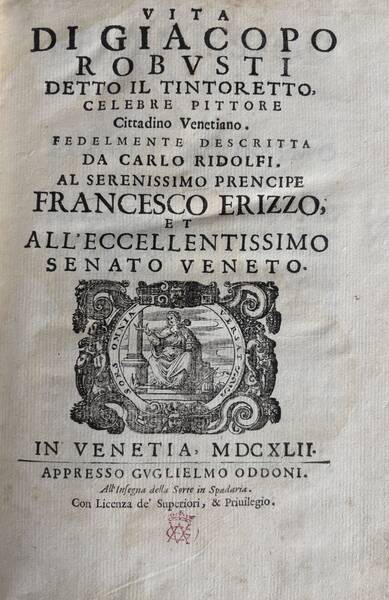
RIDOLFI, Carlo
Vita di Giacopo Robusti detto il Tintoretto, celebre pittore, cittadino venetiano.
€ 2.500
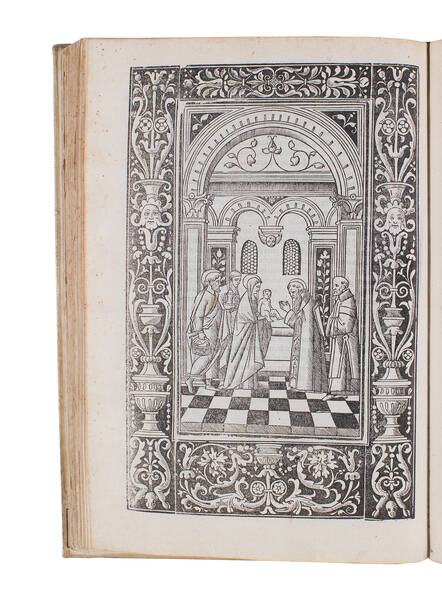
ZOCCHI, Giuseppe
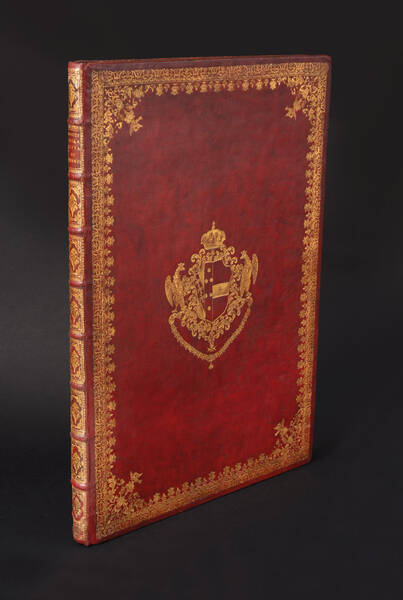
Scelta di XXIV vedute delle principali contrade, piazze, chiese, e palazzi della citta di Firenze.
€ 45.000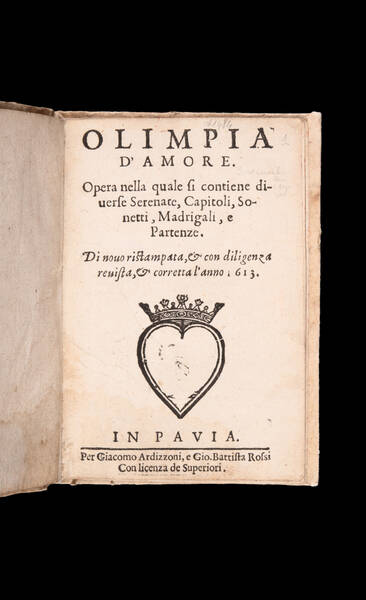
[ALESSANDRI, Baldassarre Olimpo]
Olimpia d'amore. Opera nella quale si contiene diverse serenate, capitoli, sonetti, madrigali e partenze.
€ 800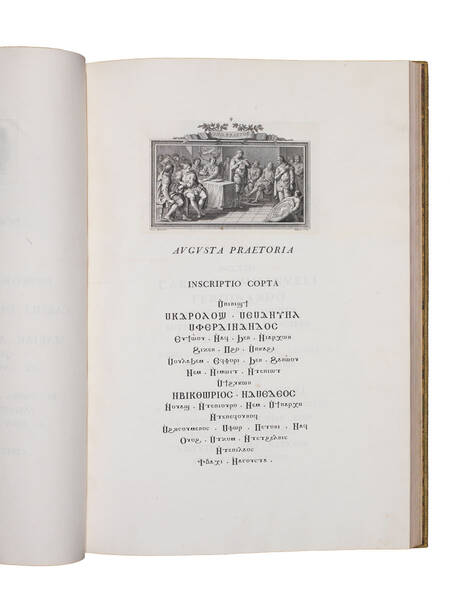
CAMPO, Antonio
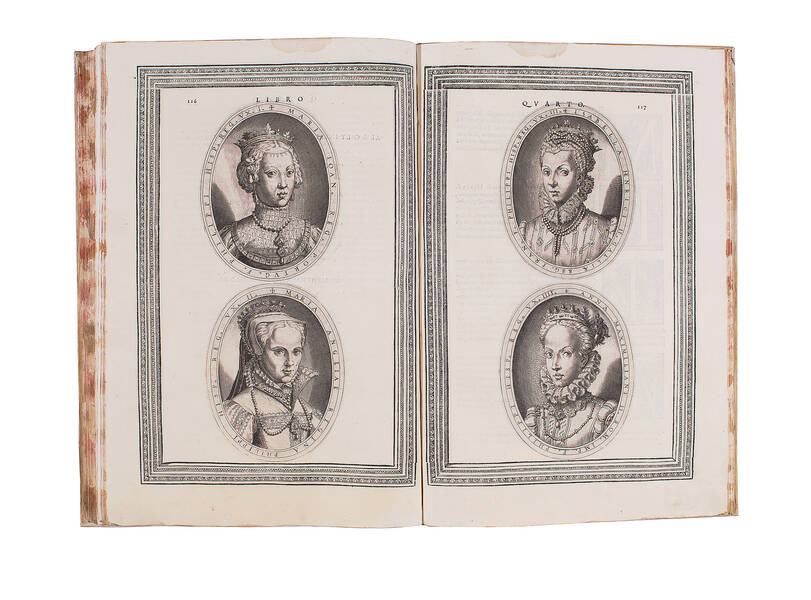
Cremona fedelissima città et nobilissima colonia de romani rappresentata in disegno col suo contado et illustrata d'vna breue historia delle cose piu...
€ 15.000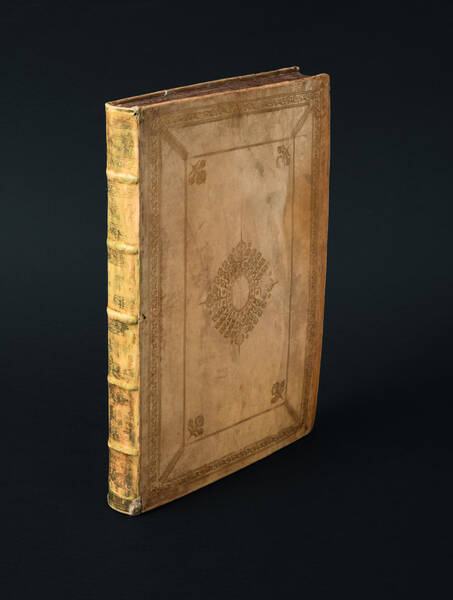
CONTILE, Luca
Ragionamento di Luca Contile sopra la proprietà delle imprese con le particolari de gli Academici Affidati et con le interpretationi et croniche.
€ 8.000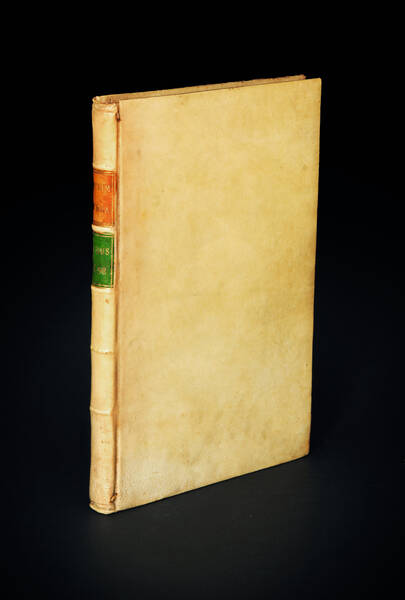
MEDA RIQUIER rare books ltd.
4 Bury Street St James's
SW1Y 6AB London
Phone +44 (0) 7770457377
info@medariquier.com