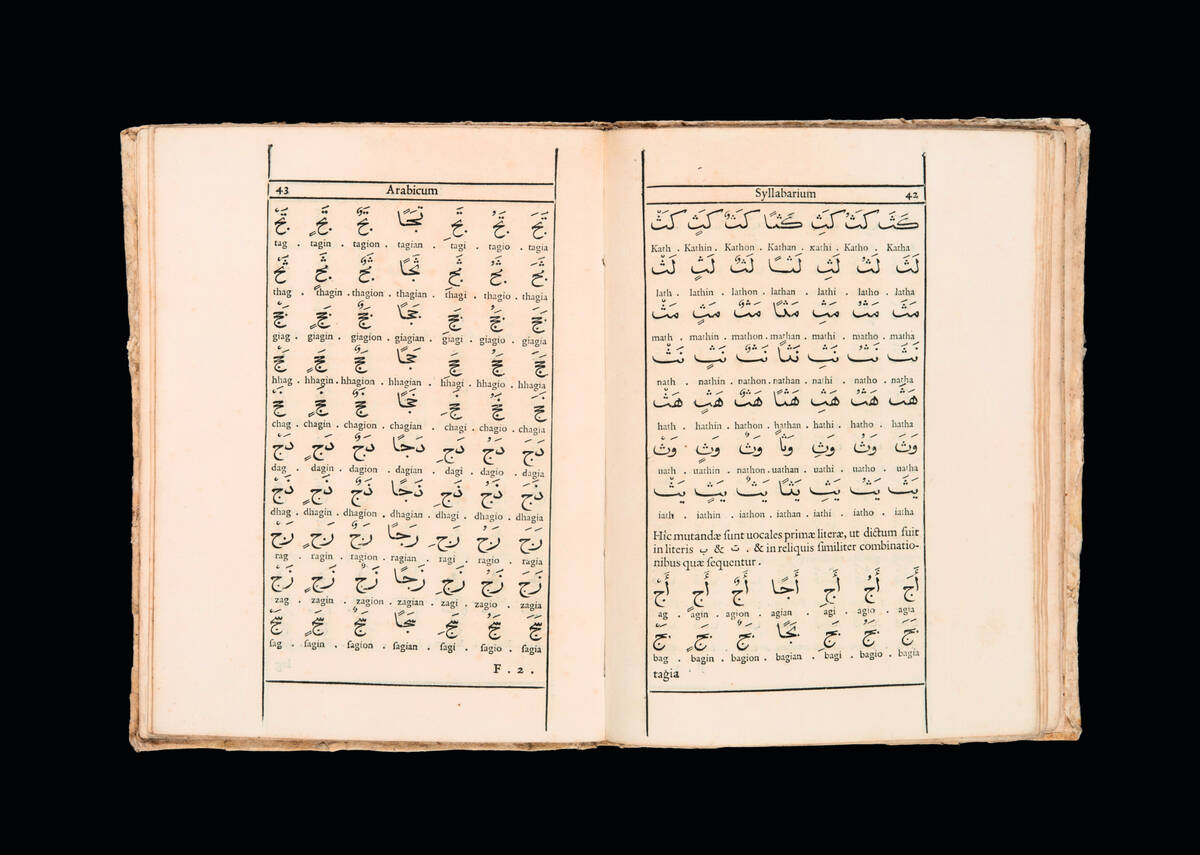
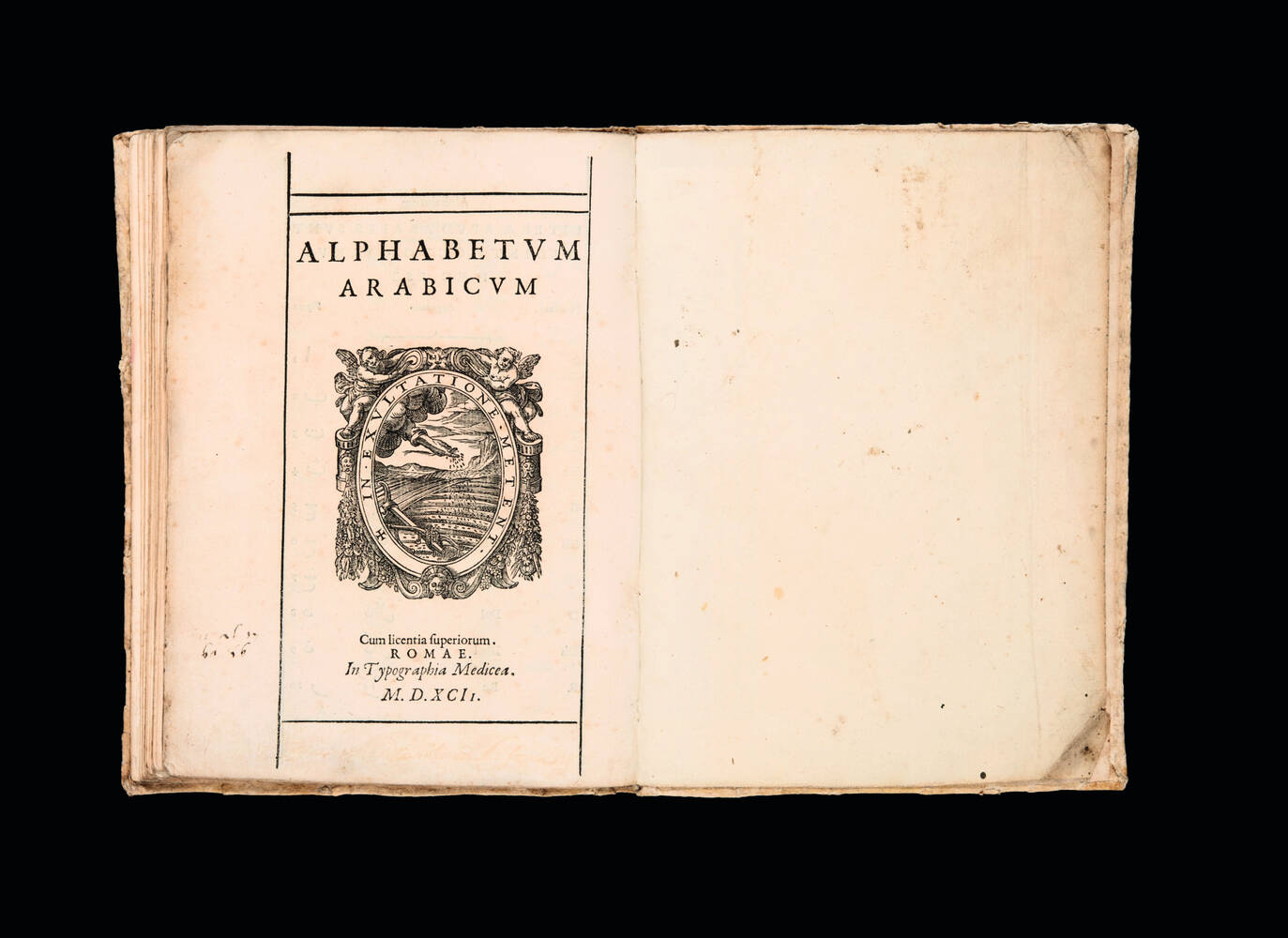
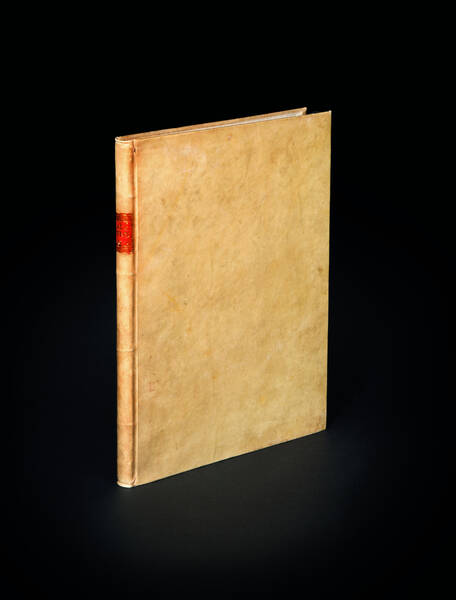
[ARABIC ALPHABET]. Alphabetum arabicum.
Rome, in Typographia Medicea., 1592Quarto (224×165mm). 64 pages. Printed in Roman and Arabic types. Printer's device on title-page. Bound in contemporary interim boards. Browning and some minor foxing throughout, binding lightly rubbed and dust-soiled. A fine, wide-margined copy.
First and only edition of Giovanni Battista Raimondi's introductory Arabic grammar, printed with Robert Granjon's Arabic types. "Often referred to as the Medici Oriental Press, [the Typographia Medicea] operated in Rome between the last decades of the sixteenth century and the beginning of the seventeenth century under the patronage of Cardinal Ferdinando de' Medici, later Grand Duke of Tuscany from 1587. The press was established in 1584 by Ferdinando, supported by Pope Gregory XIII and directed by the Orientalist and mathematician Giovanni Battista Raimondi (1536–1614). The ultimate purpose of the Typographia Medicea was, in the Pope's mind, the printing of sacred and religious texts in Oriental languages that were to be disseminated throughout the Mediterranean and the Near East. Cardinal Ferdinando, on the other hand, considered the Oriental Press as an investment through which he could gain the commercial monopoly over the book trade throughout the Levant. However, his investment was to prove unsuccessful. The press never managed to produce substantial revenues, and the initial expenses were not covered by the sales: thousands of copies remained lying in the closets of Ferdinando's palace in Rome and later were moved to several Medici residences in Florence and Pisa. In spite of the financial failure, the cultural and scientific enterprise led by Raimondi achieved great results. The high technical skills of the craftsmen involved in the making of several Oriental types, together with Raimondi's exceptional linguistic and philological expertise, allowed the Typographia to produce editions of unprecedented quality. Moreover, Cardinal Ferdinando and Raimondi put together a library that remains an extant legacy for future generations, today constituting the core of the collection of the Oriental manuscripts now kept in the Biblioteca Medicea Laurenziana in Florence." (Farina-Fani, p. 169) "Giovanni Battista Raimondi published the Alphabetum arabicum as a first step for students of Arabic. The aim of the book is to explain the orthography of Arabic script and the correct pronunciation of a vowelled text. There is some mention of calligraphic variations but the complexity of any grammatical rulings is carefully avoided. The work is simply a modest introduction to Arabic, tackling the most basic problems with clarity. […] The twenty-eight consonants that make up the Arabic Alphabet are displayed in tabular form at the beginning of the Alphabetum. In accordance with the European classical division of the letters, each letter is given its shape (figura) in Arabic script, its name (appellatio) in Arabic script and in Latin transliteration, and its phonetic value or equivalence (potestas) in Latin script, and in Hebrew script in two cases. […] Although Europeans had noticed the existence of orthographic and calligraphic variations in Arabic script, Raimondi's observations are more likely to derive from his own practical experience of the mass of manuscripts that flooded into the Medici Oriental Press at the time of the voyages of negotiation and collection." (Jones, pp. 177–79) The Alphabetum arabicum "was the product of an extravagant publishing house, well-stocked with Middle Eastern manuscripts and staffed by a team of printers, Arabic-speaking informants, and experts under the direction of Giovanni Battista Raimondi. Raimondi's editorial and translating skills are evident in the wealth of manuscript material he left behind and in the other Medicean publications; they are also unmistakably paramount in this concise and effective introduction to the Arabic alphabet. As his younger contemporaries had done, we may safely attribute the authorship of the Alphabetum arabicum to Raimondi." (ibid., pp. 127–28). "The fact that later linguists read and commented on the book, that it was an important part of the European Arabic grammatical tradition, is no proof of its success for the purpose that was intended. The Alphabetum arabicum was first and foremost a tool for missionaries. The opening page, with its medallion containing a hand sowing seed from heaven and the caption 'In exultatione metent', leaves the reader in no doubt as to the book's purpose as a teach-yourself introduction for minds motivated by missionary zeal. Whether it was successfully used in this way for the ten or twenty years before it became a philologist's curiosity is a question that remains to be answered." (ibid., p. 198)
EDIT16 CNCE 1227; Farina, Margherita & Fani, Sara. "The Typographia Medicea and the Humanistic Perspective of Renaissance Rome." In The Grand Ducal Medici and the Levant: Material Culture, Diplomacy and Imagery in Early Modern Mediterranean, edited by Maurizio Arfaioli and Marta Caroscio, 169–177. London: Harvey Miller Publishers, 2016; Jones, Robert. Learning Arabic in Renaissance Europe (1505–1624). Leiden-Boston: Brill, 2020.
Other Books
[BODONI]
Oratio Dominica in CLV linguas versa et exoticis characteribus plerumque expressa.
SOLD OUT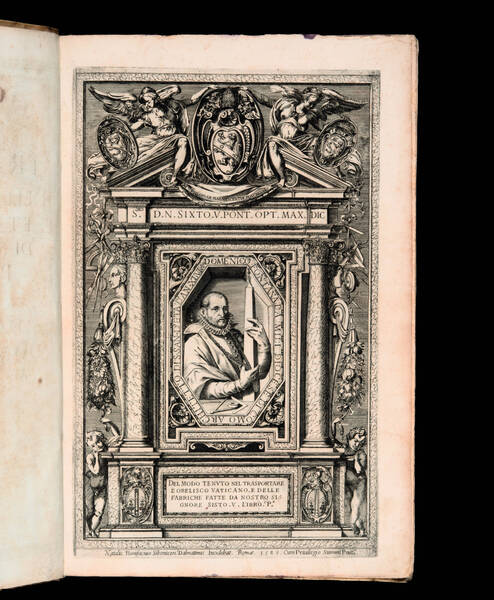
FONTANA, Domenico
Della trasportatione dell'obelisco vaticano et delle fabriche di nostro signore papa Sisto V fatte dal cauallier Domenico Fontana architetto di sua...
SOLD OUT
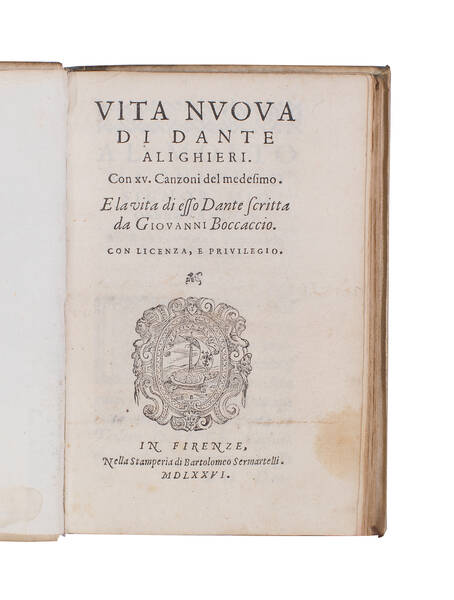
ALIGHIERI, Dante
Vita nuoua di Dante Alighieri. Con XV canzoni del medesimo. E la vita di esso Dante scritta da Giouanni Boccaccio
SOLD OUT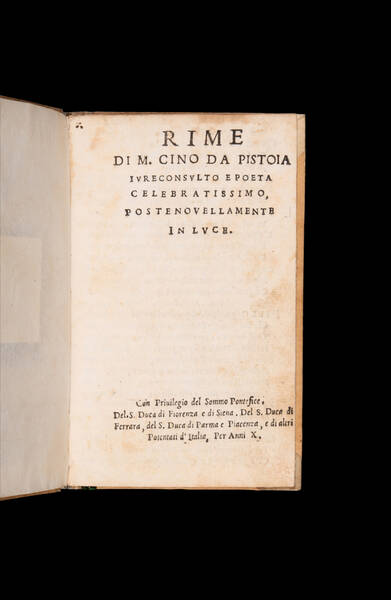
VALVASONE, Erasmo da
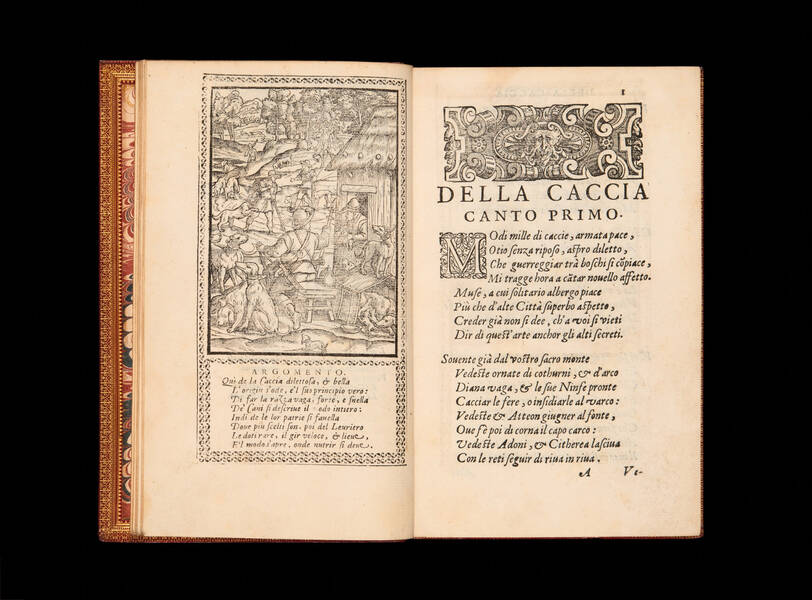
Della caccia poema del signor Erasmo di Valuasone. All'ill. signor Cesare di Valuasone suo nepote. Con gli argomenti a ciascun canto del sig. Gio....
€ 3.500
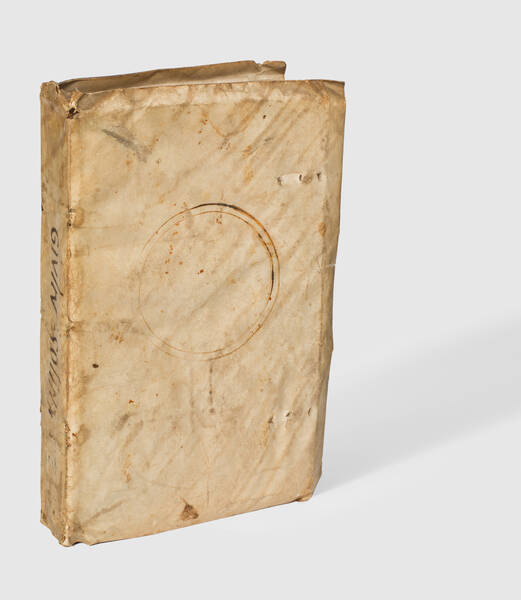
POMPONIUS MELA, IULIUS SOLINUS
Itinerarium Antonini Aug. Vibius Sequester. P. Victor de regionibus urbis Romae. Dionysius Afer de Situ orbis Prisciano interprete
SOLD OUT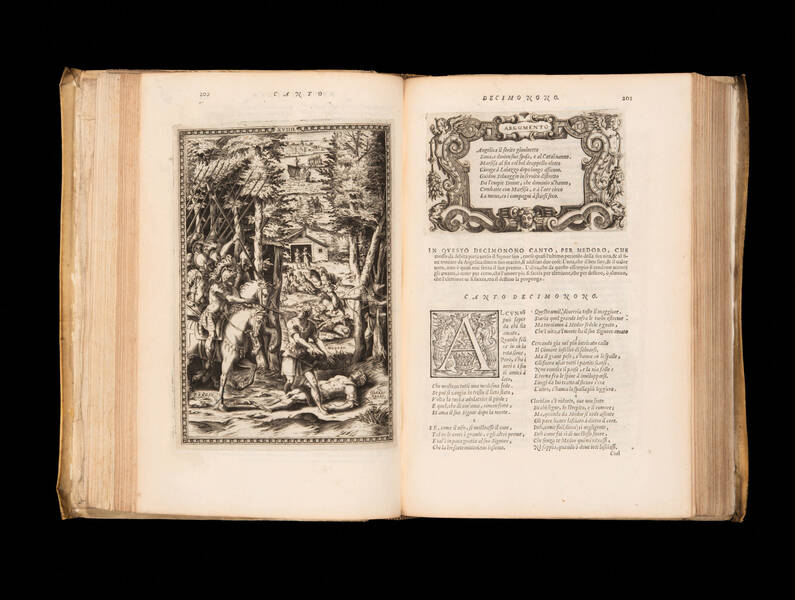
ARIOSTO, Ludovico
Orlando furioso di m. Lodouico Ariosto nuouamente adornato di figure di rame da Girolamo Porro padouano et di altre cose che saranno notate nella...
SOLD OUT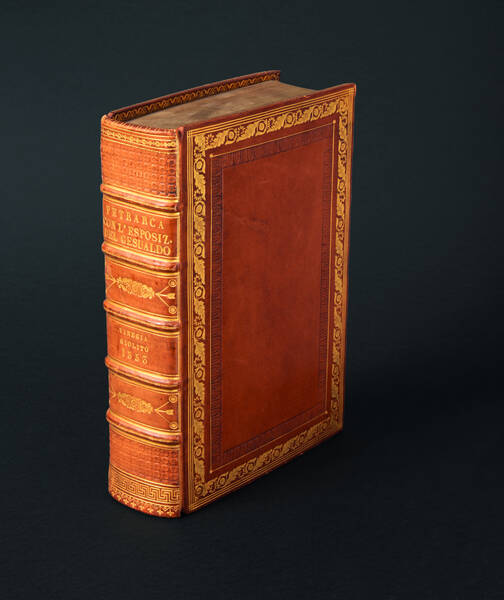
PETRARCA, Francesco
Il Petrarcha con l'espositione di m. Giouanni Andrea Gesualdo, nuouamente ristampato, e con somma diligenza corretto, con nuoua tauola di tutte le...
SOLD OUT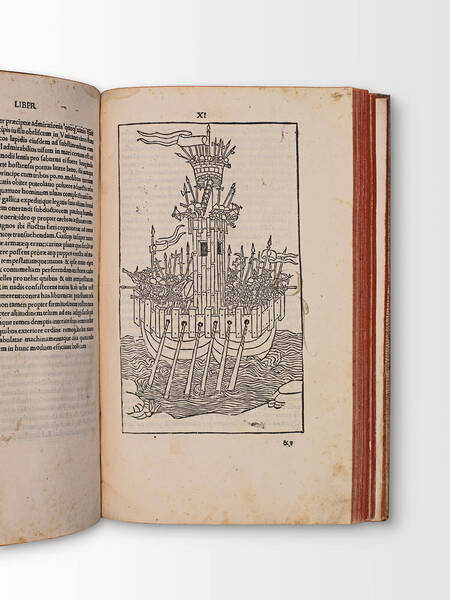
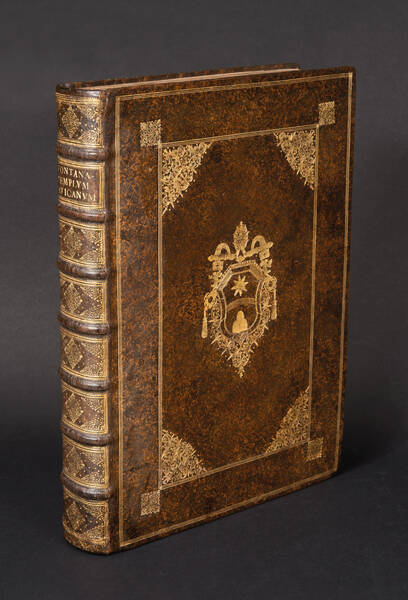
FONTANA, Carlo
Templum Vaticanum et ipsius origo cum aedificiis maximè conspicuis antiquitùs, & recèns ibidem constitutis; editum ab equite Carolo Fontana ... opus...
€ 38.000
MEDA RIQUIER rare books ltd.
4 Bury Street St James's
SW1Y 6AB London
Phone +44 (0) 7770457377
info@medariquier.com