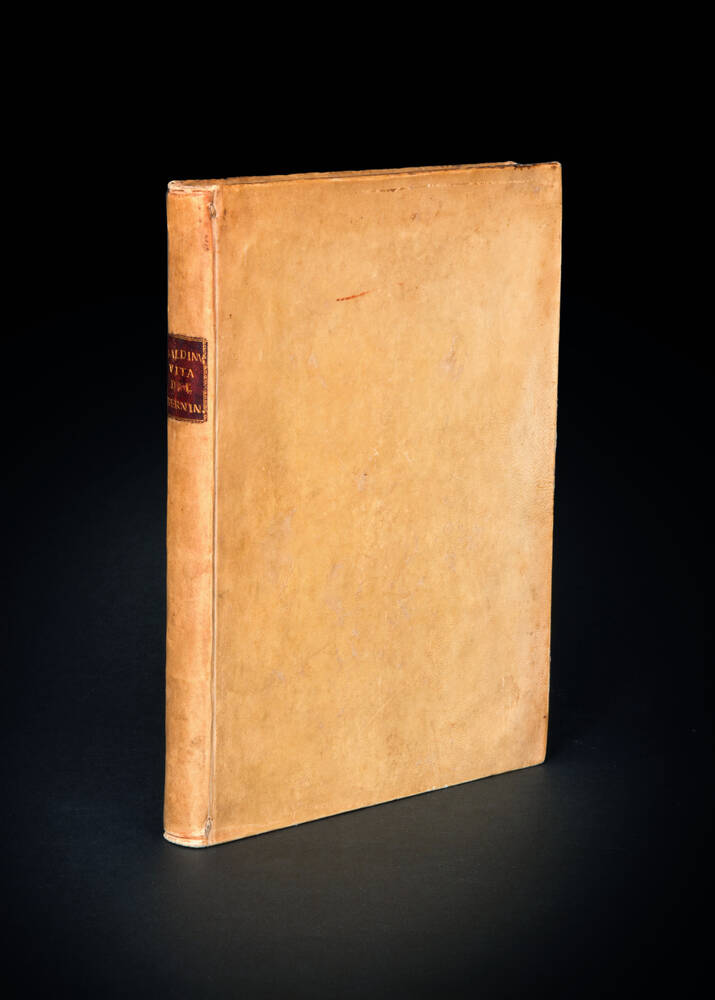
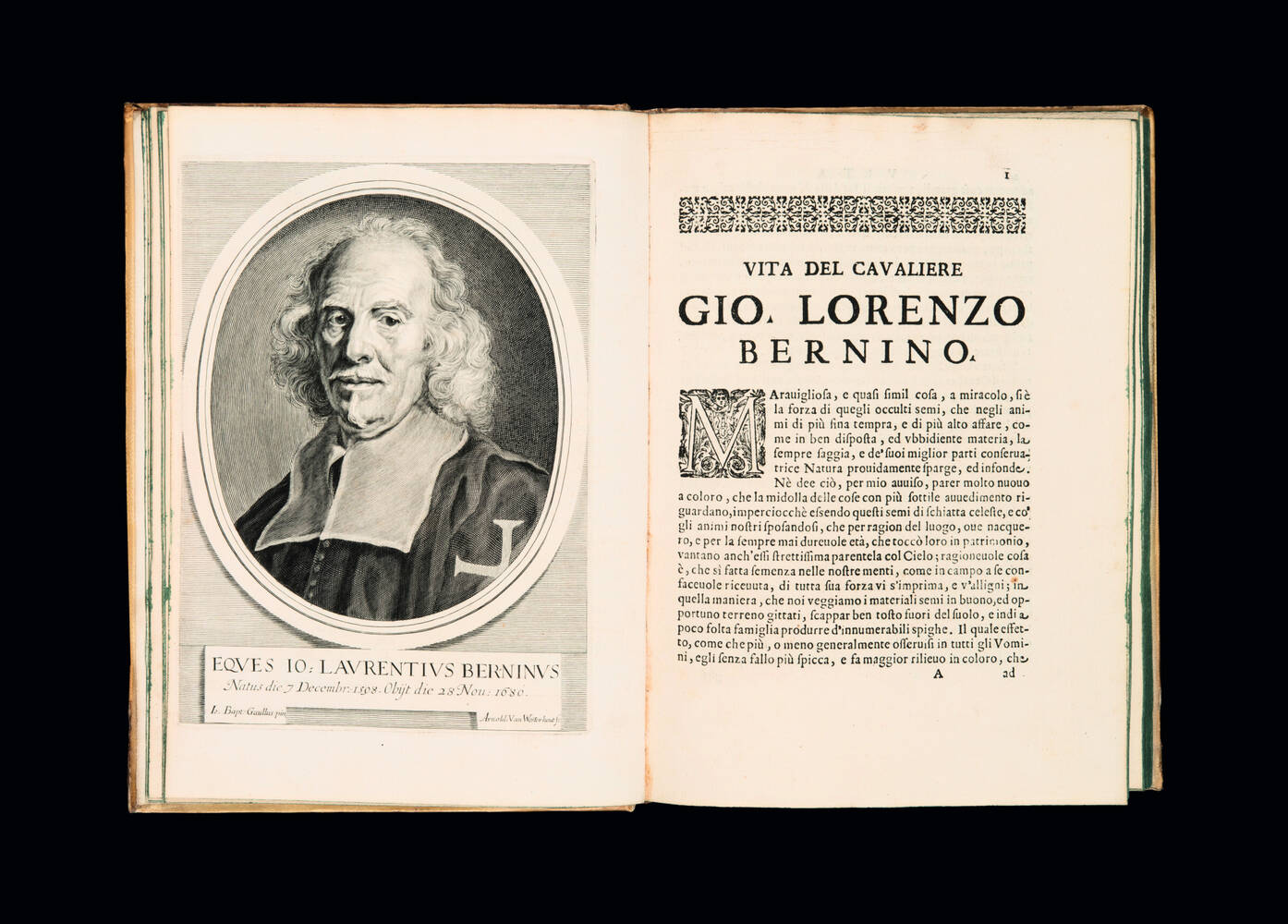
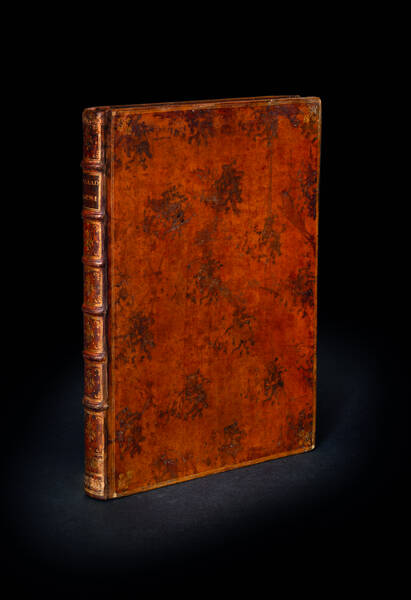
BALDINUCCI, Filippo. Vita del cav. Gio. Lorenzo Bernino, scultore, architetto, e pittore, scritta da Filippo Baldinucci fiorentino, alla sacra e reale maestà di Cristina regina di Svezia.
Florence, nella stamperia di Vincenzo Vangelisti., 1682.Quarto (270×194mm). [12], 112 pages with a full-page portrait of Bernini by Arnold van Westerhout after Giovanni Battista Gaulli, 9 plates, four folded. A very fine copy bound in early XVIII century stiff vellum, with morocco lettering-piece on spine from the library of Marquis Giuseppe Arconati Visconti (monogram stamp on title-page) and A. & M. Moatti (ex-libris).
First edition of the first ever printed biography of Gian Lorenzo Bernini. "Filippo Baldinucci (1625–1696) is widely known for his historical and philological writings. Of all his works the one that has proved most valuable to the art historian (if the frequency with which it is cited is any indication) is his Life of Bernini. It is useful, of course, because it tells us what Bernini did (lost works that we know of because they are mentioned in Baldinucci are still turning up), but above all its value lies in the picture it gives us of a great artist as seen through the eyes of a highly knowledgeable and sensitive contemporary. Baldinucci was a connoisseur with a keen eye for style. In sharp contrast to the majority of seventeenth century critics, he understood and admired the Baroque." (Robert Enggass and Jonathan Brown, Italy and Spain 1600-1750 Sources and Documents Englewood Cliffs: Prentice-Hall, 1970, 110–122) "Baldinucci must have been perfectly aware of Bernini's genius well before he was commissioned to write his biography: Florence had immediately shown great interest in the artist, who was nevertheless considered Florentine. Through Paolo Falconieri, Cardinal Leopoldo [Leopoldo de' Medici (1617 – 1675)] was always in contact with Bernini and collected his drawings, also taking an interest in his architectural works: in 1657 he requested and received directly from the artist drawings of the colonnade of St. Peter's and was later involved in various projects and consultations in Florence, welcomed with the honors of the court during the trip to Paris. Since the 1670s, Baldinucci had planned to write a Life of Bernini, coming into direct contact with the artist and his children and perhaps, according to his method, soliciting information organized according to his own questionnaire. An exponent of a Florentine historiographical tradition of the arts still considered glorious and authoritative, and a systematic collector of artists' biographies whose first volume, at Bernini's death in 1680, was already being published together with the Vocabolario toscano dell'arte del disegno, Baldinucci - according to what his son Francesco Saverio reported - on the occasion of his only stay in Rome in April-May 1681 was commissioned by Queen Christina of Sweden to draft Bernini's biography as a ‘vita a parte', that is, as an independent book. Christina would have taken care of 'providing him with all the information he needed in abundance and with certainty', also involving Bernini's children […]." (traslated from: Mario Bevilacqua, Baldinucci Notizie sull'architettura. In: Storia della critica d'arte. 2018) The greatest artist of the Baroque era had disappeared in the whirlwind of an exalted and opposed fame. Substantially the Life of Cav. G. L. Bernino, Florence 1682, was meant to be the artist's defense against the accusations of his detractors, especially that of having compromised the stability of Michelangelo's dome with the work on the pillars of St. Peter's Basilica. Baldinucci immediately set to work, collecting the testimonies of his sons and students, especially Mattia De' Rossi, and of the well-informed painters Carlo Maratta and Filippo Lauri, as well as consulting the documents in the archives of the Fabbrica di S. Pietro (especially the Libri congregationum, minutes of the sessions). The result was one of the liveliest portraits of Bernini's exceptional personality, a colorful and sometimes dramatic account of the very singular events of his life and at the same time an accurate reconstruction of his work. Adding value to the biography is the transcription of Bernini's "poetics", the story of his confidences, his outbursts, his preferences, in a theater that has as its backdrop the Roman and French courts and the highest society of the time.
Berlin Kat., 2670; Cicognara 2197; Fowler 27.
Other Books
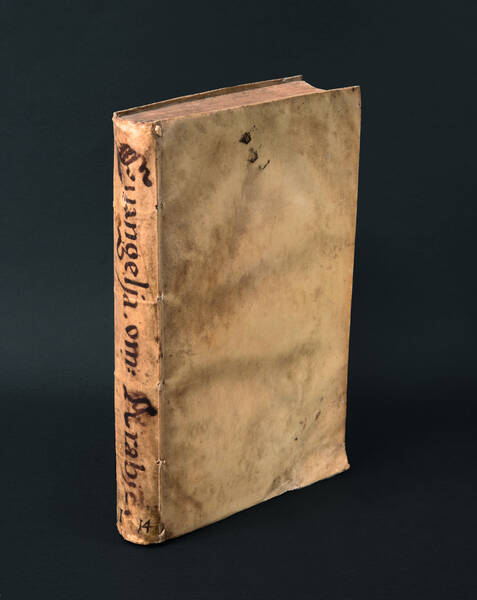
[BIBLIA ARABICA]
Evangelium Iesu Christi quemadmodum scripsit Mar Mattheus unus ex duodecim discipulis eius.
€ 11.000![Tragoediae septem cum commentariis. [Greek] Edited by Johannes Gregoropoulos Cretensis].](https://www.medariquier.com/typo3temp/pics/a7f4ddada3.jpeg "Tragoediae septem cum commentariis. [Greek] Edited by Johannes Gregoropoulos Cretensis].")
SOPHOCLES
Tragoediae septem cum commentariis. [Greek] Edited by Johannes Gregoropoulos Cretensis].
SOLD OUT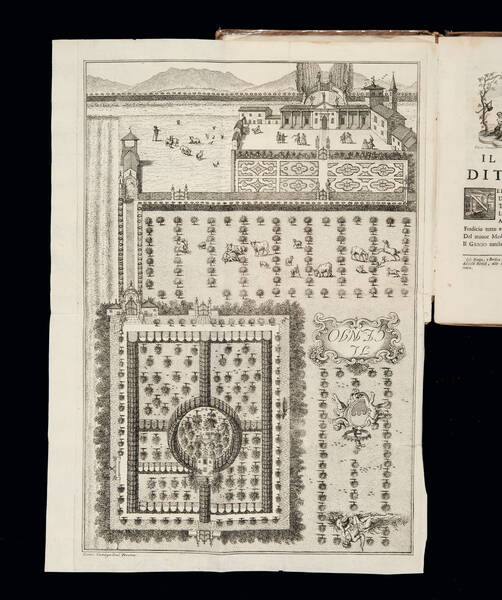
ACANTI, Aureliano (CANATI, Valeriano)
Il Roccolo ditirambo di Valeriano Acanti Acc. Olimpico Vicentino.
€ 5.000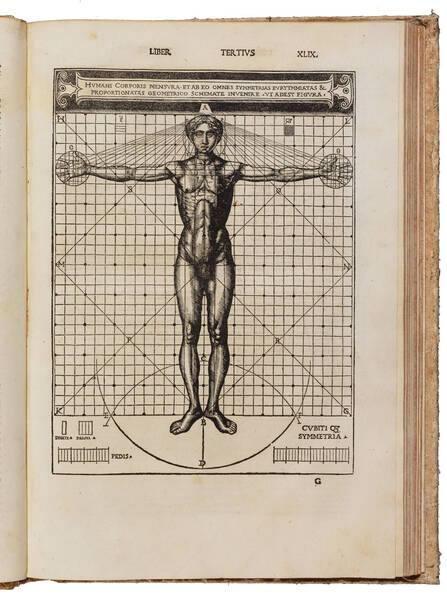
GILBERT, William
De magnete, magneticisque corporibus, et de magno magnete tellure; Physiologia nova, plurimis & argumentis, & experimentis demonstrata.
SOLD OUT
TASSO, Torquato
La Gerusalemme liberata di Torquato Tasso con le figure di Giambatista Piazzetta, alla Sacra Real Maestà di Maria Teresa d’Austria, regina...
€ 18.000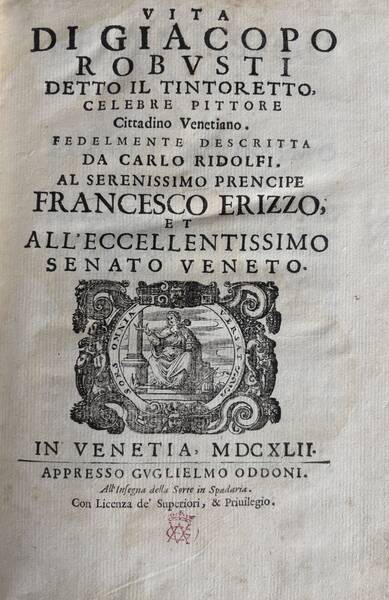
RIDOLFI, Carlo
Vita di Giacopo Robusti detto il Tintoretto, celebre pittore, cittadino venetiano.
€ 2.500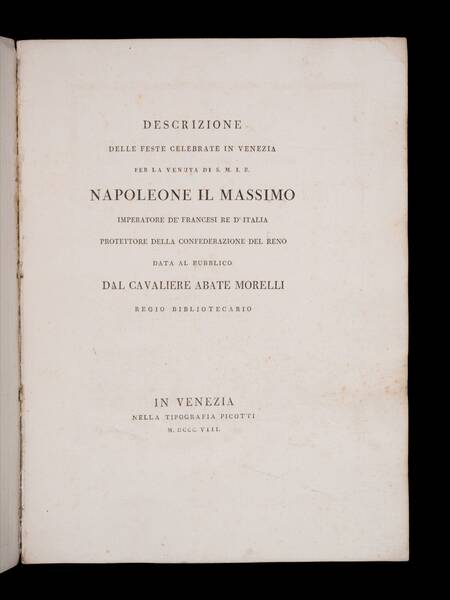
MORELLI, Jacopo
Descrizione delle feste celebrate in Venezia per la venuta di S.M.I.R. Napoleone il Massimo imperatore de' Francesi re d'Italia protettore della...
€ 1.500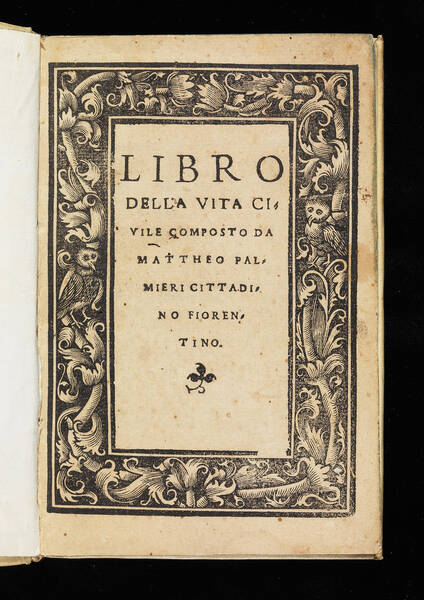
PALMIERI, Matteo
Libro della vita civile composta da Mattheo Palmieri cittadino fiorentino.
SOLD OUT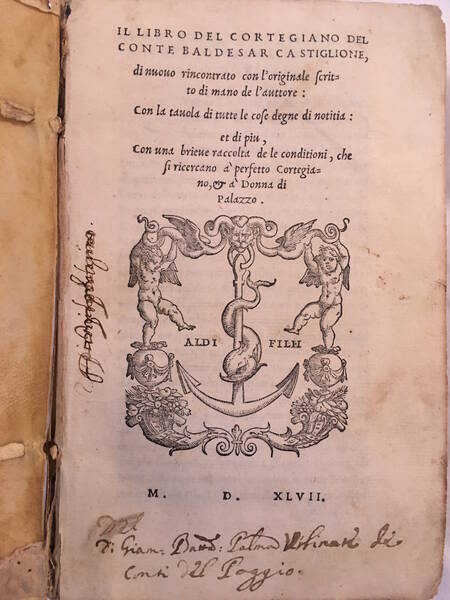
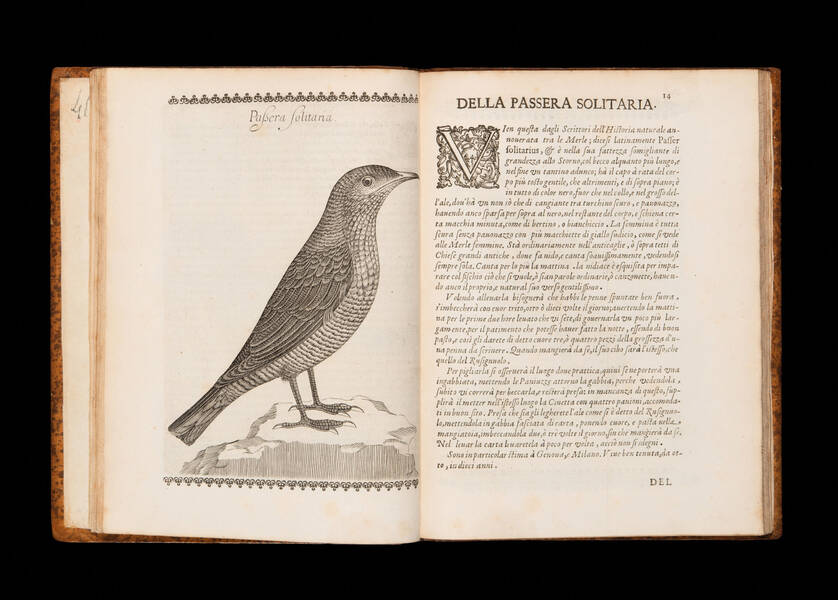
OLINA, Giovanni Pietro
Vccelliera ouero discorso della natura, e proprieta di diuersi vccelli, e in particolare di que' che cantano. Con il modo di prendergli, conoscergli,...
€ 6.000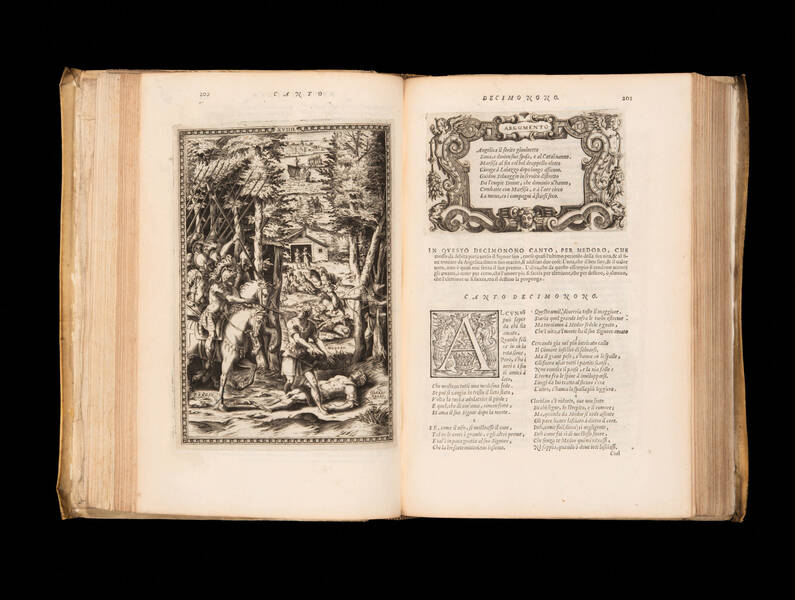
ARIOSTO, Ludovico
Orlando furioso di m. Lodouico Ariosto nuouamente adornato di figure di rame da Girolamo Porro padouano et di altre cose che saranno notate nella...
SOLD OUT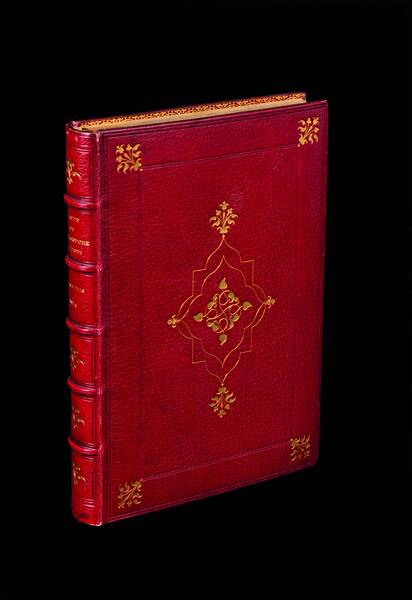
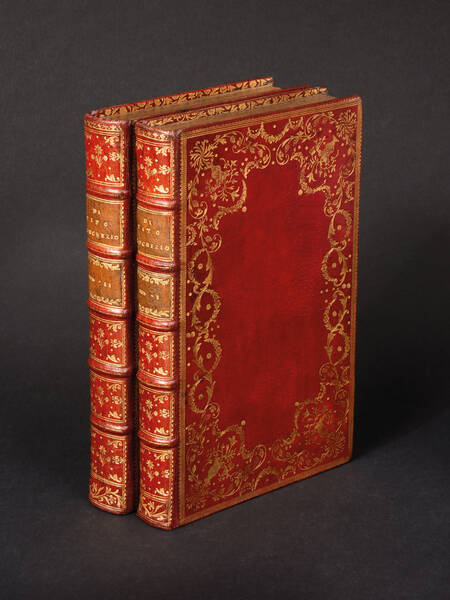
LUCRETIUS, Titus Carus
Della natura delle cose libri sei, tradotti dal Latino in Italiano da Alessandro Marchetti. Dati nuovamente in luce da Francesco Gerbault.
€ 7.000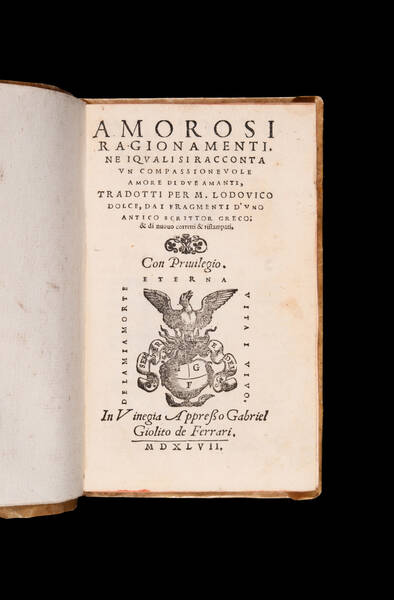

MEDA RIQUIER rare books ltd.
4 Bury Street St James's
SW1Y 6AB London
Phone +44 (0) 7770457377
info@medariquier.com