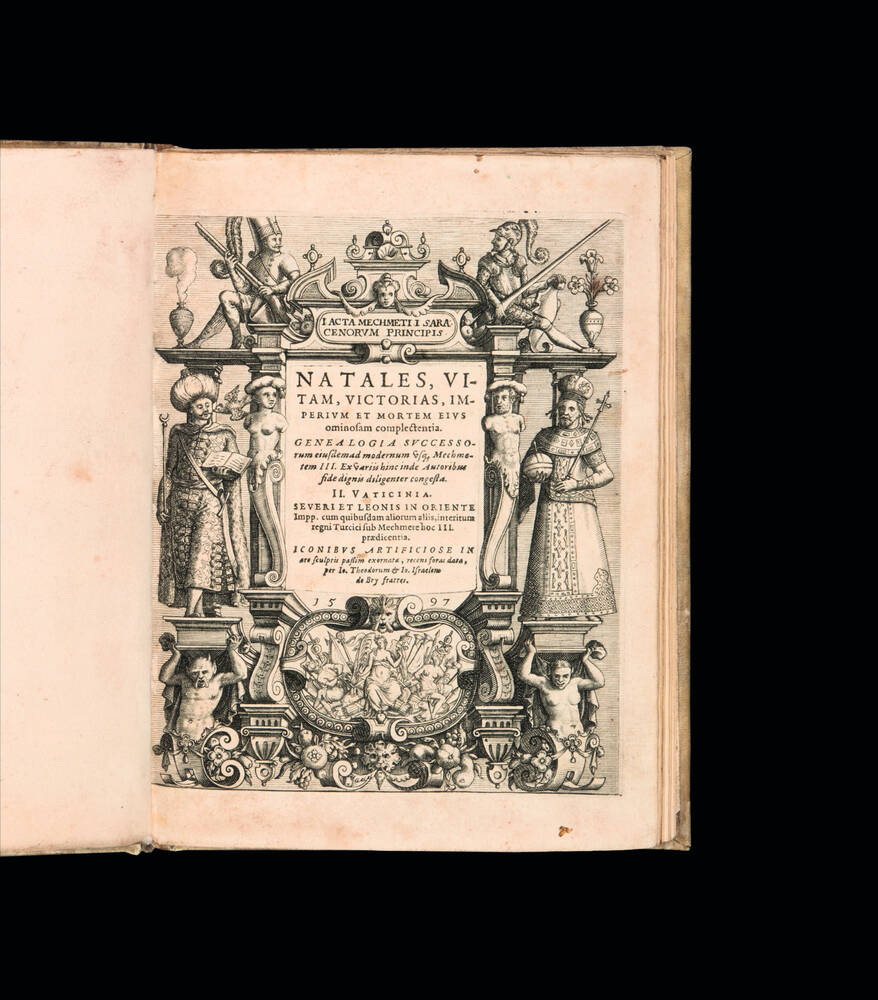
[DE BRY, Johann Theodor & Johann Israel]. I. Acta Mechmeti I Saracenorum principis. Natales, vitam, victorias, imperium et mortem eius ominosam complectentia. Genealogia successorum eiusdem ad modernum usque Mechmetem III. II. Vaticinia Severi et Leonis in oriente impp. cum quibusdam aliorum aliis, interitum regni Turcici sub Mechmete hoc III praedicentia.
[Frankfurt], per Io. Theodorum & Io. Israelem de Bry fratres., 1597.Quarto (199×146mm), 2 parts in one volume. I: [4] leaves, pages 1–58, [1] leaf; II: pages 59–96, [3] leaves. Engraved title-page within architectural border, the Prophet Muhammad and a Byzantine emperor at the sides. Twenty- six engravings, various historiated initials and typographical ornaments throughout. Contemporary stiff vellum binding, remounted. Rather browned, especially in quires D and N, some minor spotting and foxing, else a very good copy.
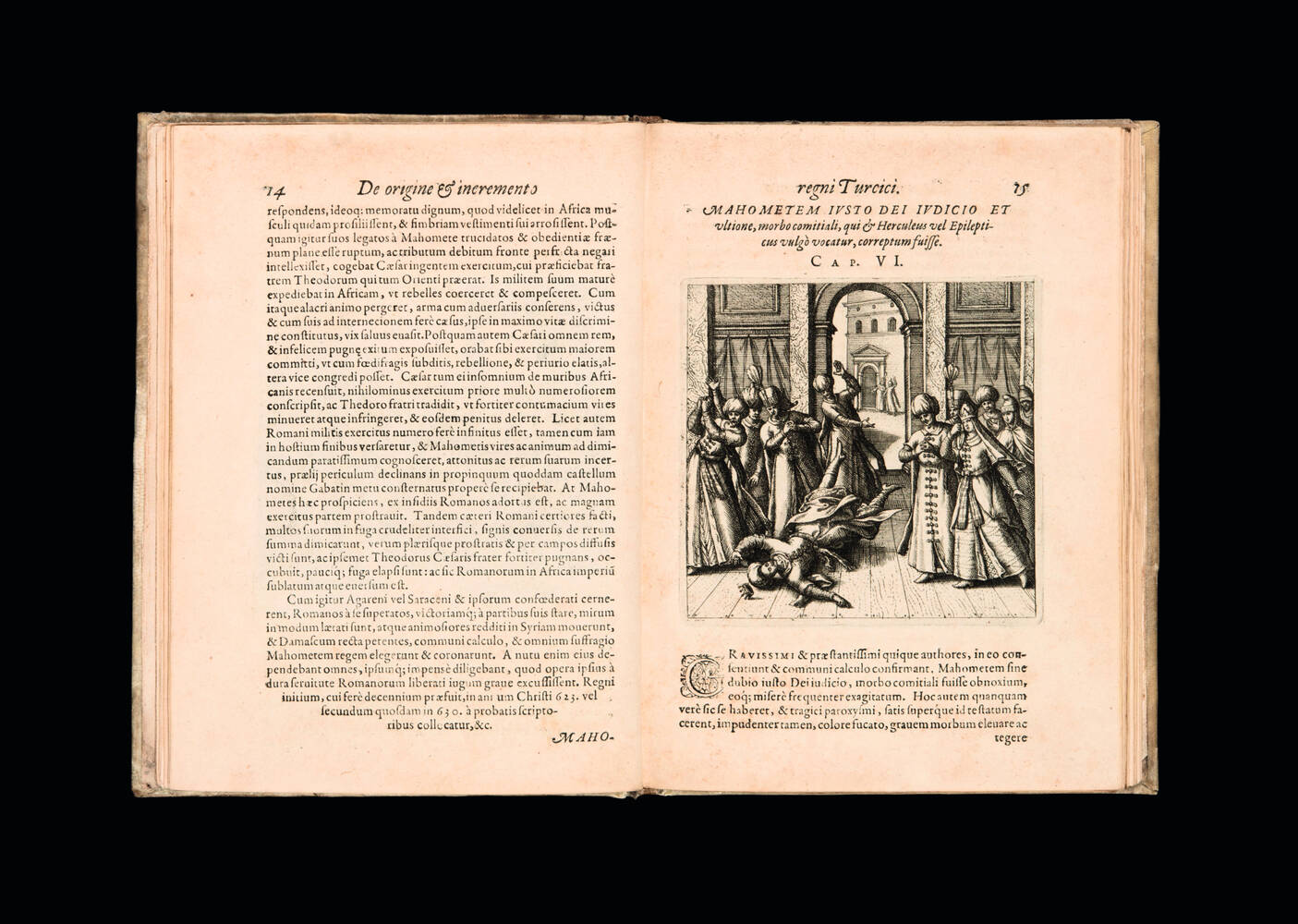
First edition of "the first printed Western book to illustrate the life of the Prophet Muhammad" (Ilg, p. 241). The book's editors, the brothers Johann Theodor and Johann Israel de Bry, worked in Frankfurt and are best known for their illustrated editions of travel accounts from Asia and the Americas. Although the author of this volume is anonymous, they are most likely to be identified as Jean-Jacques Boissard, a scholar and humanist who frequently collaborated with the de Bry printing house until his death in 1602. Boissard had previously written a collection of biographies of Ottoman sultans, printed in 1596, and it seems apparent that the Acta Mechmeti could be a complement to this earlier work. Boissard also provided the drawings on which the engravings for his editions were based; therefore, it is probable that the twenty-six illustrations in this volume were also based on his drawings. The first part of the book contains not only a biography of Muhammad, but also a presentation of the basic principles of Islam, a brief history of the Arabic caliphates up to the year 1300, a summary of the customs of the Armenians and the Georgians, and finally a history of the Ottoman sultans from 1300 to 1595. The second part of the book is a collection of prophecies about the decline of the Ottoman Empire that were popularly attributed to the Byzantine emperor Leo VI. "The nine engravings that accompany the life of Muhammad — the only section of the Acts to receive illustrations — give the textual arguments a dramatic turn: the engravings always represent the most spectacular, climactic moment of each of the narrated episodes. Muhammad is, for example, caught groping his mistress or tumbling down due to an epileptic fit. Certainly, these engravings illustrate only the most salient points of the Christian criticism of Muhammad and of his doctrines. Hence, his ignoble family origin, his lecherous behavior, and the fact that he was a trickster who cheated people by fabricating false miracles were highlighted. However, the illustrator did not give Muhammad the aspect of a demoniac, deformed, or harmed creature, as frequently had been the case in Western art. Instead, the characters who appear in these engravings have been treated in a matter-of- fact way: the illustrator considered the costume figures published in 1567 by the French royal geographer Nicolas de Nicolay in his travel report from the Ottoman Empire (Navigations et peregrinations orientales) as the best available approximations of the true appearance of the historic Muhammad and his contemporaries. The young Muhammad is therefore — due to a misunderstanding of the prototypal image — dressed in the hood and cloak of de Nicolay's Turkish girl" (ibid., p. 252). "The decision to represent Muhammad and his contemporaries as if they were sixteenth-century Ottomans may seem anachronistic today. The sixteenth-century reader of the Acts, however, must have had a quite different point of view. During the first half of the century, the image of the Turk had become instrumental in the polemics between the Protestant and Catholic denominations. Innumerable Reformation broadsheets had depicted a Turk as personification of heresy and false doctrine next to either the pope or a Lutheran preacher. By conferring to his Muhammad the appearance of an Ottoman, the illustrator of the Acts used this established iconographic tradition to characterize Muhammad even more effectively as a pseudo- prophet. Further, the curious "ottomanization" of Muhammad was a result of the opinion, expressed not only in the Acts, that Muhammad was succeeded as "rex" by a series of Saracen rulers and finally by the Ottoman sultans. The Ottomans were therefore widely considered to be Muhammad's heirs, Islam became the "Turkish religion" and the content of the Qur'an the "Turkish law" (Ilg, p. 258). The second part of the volume contains the Vaticinium Severi et Leonis imperatorum ("The Prophecy of the Emperors Leo and Severus"). It is a prophetic forgery that was attributed to Leo VI the Wise, emperor of Byzantium from 886 to 912, and to the Roman emperor Antoninus Severus, better known as Caracalla (211–217). It consists of sixteen poems, each paired with an allegorical illustration and followed by an explanation, which foretell the imminent fall of the Ottoman rule. The Oracles of Leo the Wise were widely read throughout the late Middle Ages and early modern period, and they were routinely reinterpreted in light of the current political context. Their first printed edition appeared in Brescia in 1596, containing Latin and Italian text; the present edition reprints the Latin text of this first edition and
almost exactly replicates its sixteen engravings.
Cicognara 1863; Ilg, Ulrike, "Religious Polemics and Visual Realism in a Late 16th Century Biography of the Prophet Muhammad." The Image of the Prophet between Ideal and Ideology: A Scholarly Investigation, ed. by Christiane Gruber and Avinoam Shalem, pp. 241–59. Berlin: Walter de Gruyter, 2014.
Other Books
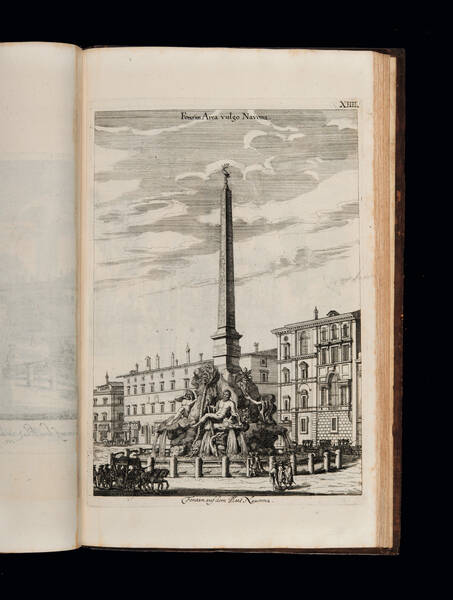
FALDA, Giovanni Battista
Romanorum fontinalia, sive nitidissimorum perenniumque, intra et extra, Urbem Romam, fontium vera, varia, et accurata delineatio.
SOLD OUT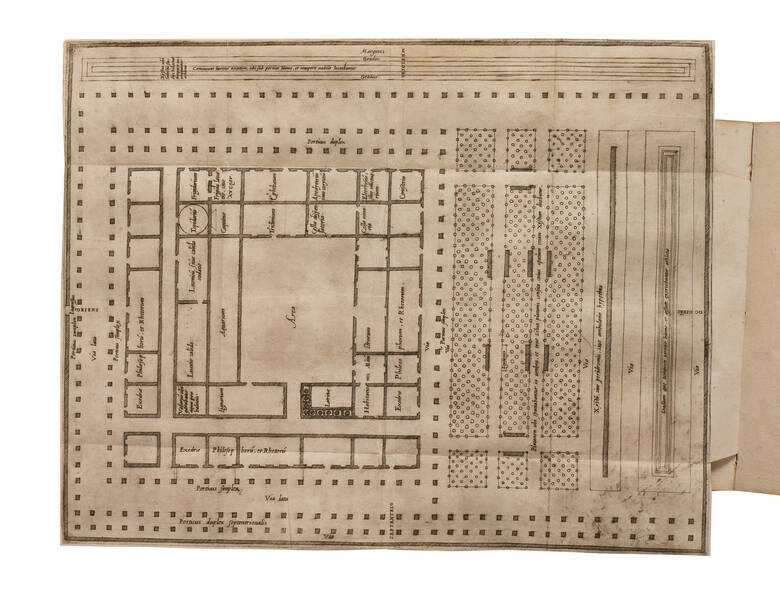
MERCURIALE, Girolamo
Artis gymnasticae apud antiquos celeberrimae, nostris temporibus ignoratae, libri sex.
SOLD OUT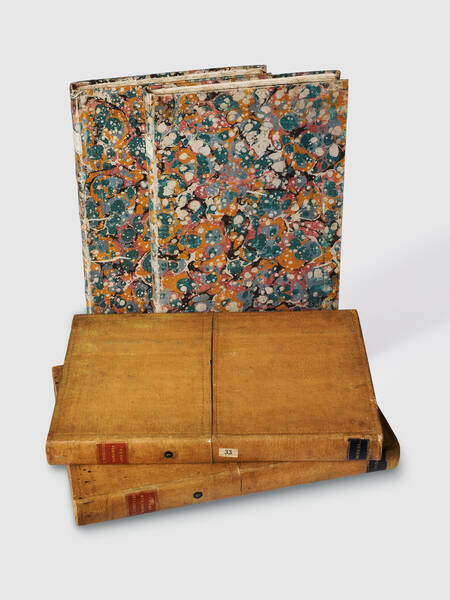
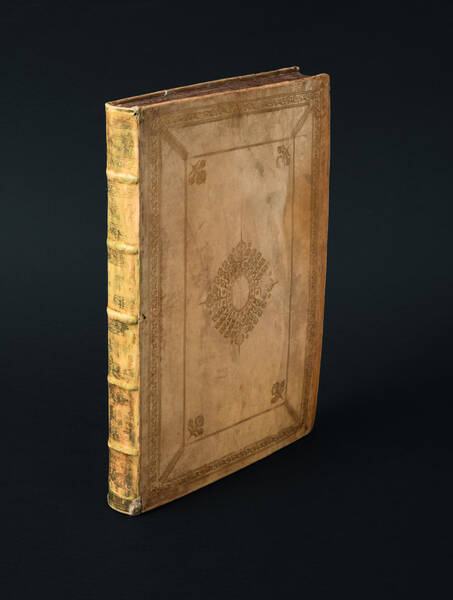
CONTILE, Luca
Ragionamento di Luca Contile sopra la proprietà delle imprese con le particolari de gli Academici Affidati et con le interpretationi et croniche.
€ 8.000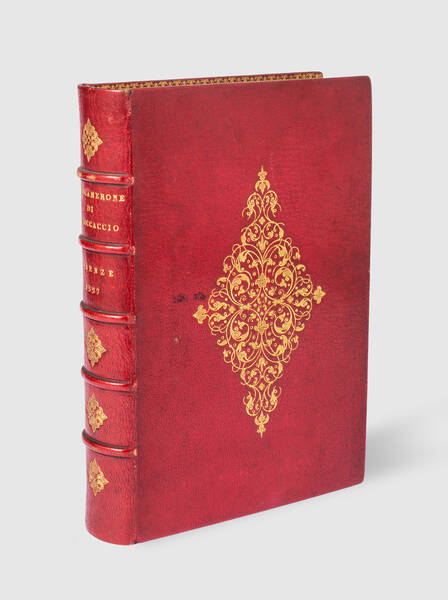
BOCCACCIO, Giovanni
Il Decamerone di m. Giouanni Boccaccio nuouamente corretto et con diligentia stampato.
SOLD OUT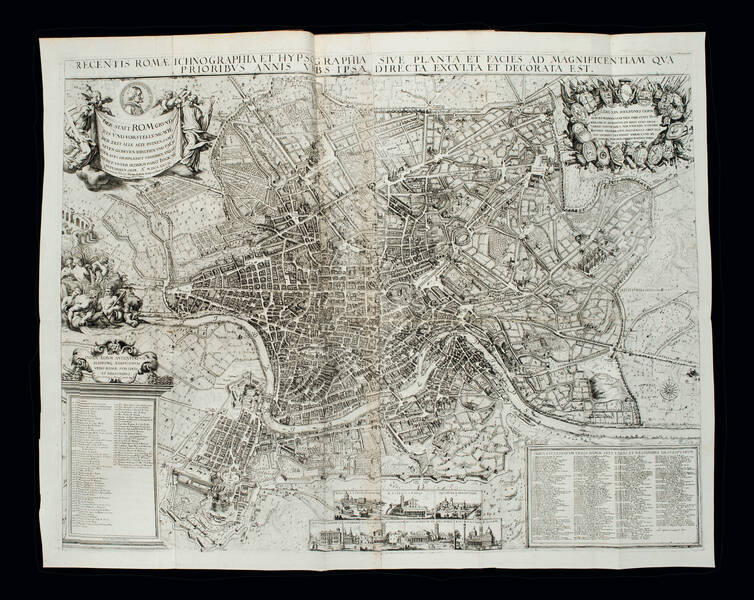
SANDRART, Joachim von
Romae antiquæ et novæ theatrum; sive, genuina ac vera urbis, juxta varios ejusdem status, delineatio topographica.
SOLD OUT![Trattato della natura de’ cibi et del bere [...] nel quale non solo tutte le virtù, & i vitij di quelli minutamente si palesano; ma anco i rimedij per correggere i loro difetti copiosamente s’insegnano.](https://www.medariquier.com/typo3temp/pics/d4e0248596.jpeg "Trattato della natura de’ cibi et del bere [...] nel quale non solo tutte le virtù, & i vitij di quelli minutamente si palesano; ma anco i rimedij per correggere i loro difetti copiosamente s’insegnano.")
PISANELLI, Baldassarre
Trattato della natura de’ cibi et del bere [...] nel quale non solo tutte le virtù, & i vitij di quelli minutamente si palesano; ma anco i rimedij...
SOLD OUT
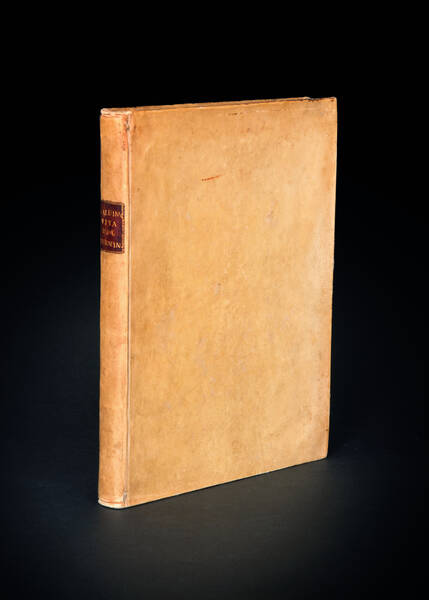
BALDINUCCI, Filippo
Vita del cav. Gio. Lorenzo Bernino, scultore, architetto, e pittore, scritta da Filippo Baldinucci fiorentino, alla sacra e reale maestà di Cristina...
€ 5.000
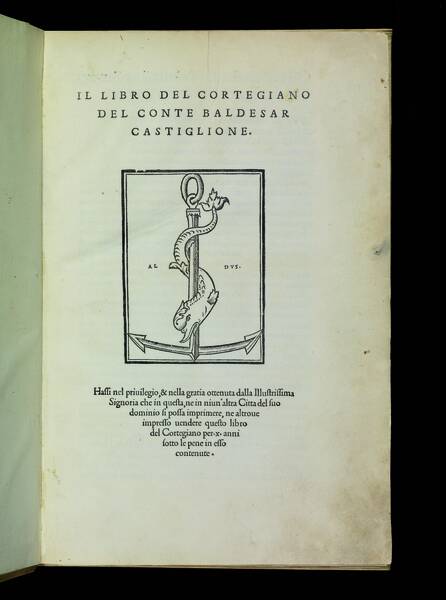
![Opera posthuma [Compendium grammatices linguae hebraeae].](https://www.medariquier.com/typo3temp/pics/9e46dbc214.jpg "Opera posthuma [Compendium grammatices linguae hebraeae].")
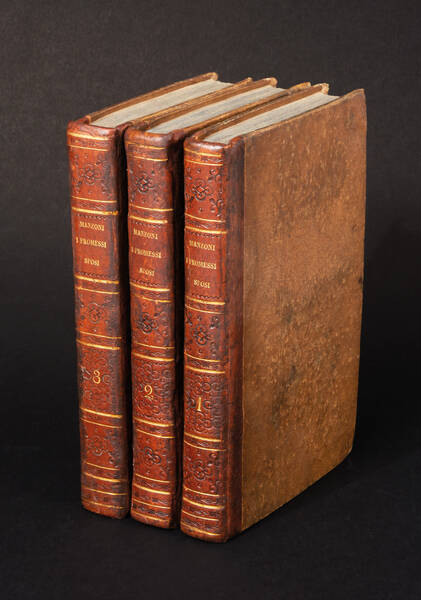
MANZONI, Alessandro
I promessi sposi, storia milanese del secolo XVII scoperta e rifatta da Alessandro Manzoni.
€ 11.500
MEDA RIQUIER rare books ltd.
4 Bury Street St James's
SW1Y 6AB London
Phone +44 (0) 7770457377
info@medariquier.com